
 back to list
A customer clicks “return” and most ecommerce teams hear a cash register running backward. The sale reverses, a package travels back, a refund leaves the account, and an item lands in a queue that may or may not put it back on the shelf. That reflex, treating the return as the failed end of a transaction, is the single most expensive mistake an online retailer can make about returns.
The economics are more nuanced. Returns are routine across Europe: in Sendcloud’s 2026 survey, 41% of shoppers had returned at least one online order in the previous three months, and returns run several times higher online than in store. In Germany, the EU’s highest-returning market, a University of Bamberg study found almost one in four ecommerce parcels was returned in 2021, and a separate 2022 retailer survey put the fashion return rate at almost 34%. A retailer that designs for that reality recovers revenue, keeps customers, and learns what to fix. A retailer that improvises loses all three.
This guide treats ecommerce returns management as an operating system rather than a complaint to absorb. It covers the policy, the portal, the software, the reverse logistics, and the data, with specific attention to the European layer that most advice written for the U.S. market quietly ignores.
What returns management in ecommerce actually covers
Returns management in ecommerce is the full set of decisions and operations that begin the moment a customer wants to send something back and end only when that item is resold, refurbished, recycled, or written off and the customer is made whole. People shorten it to “handling returns,” which makes it sound like a help-desk task. It is closer to running a second, reverse supply chain alongside your forward one.
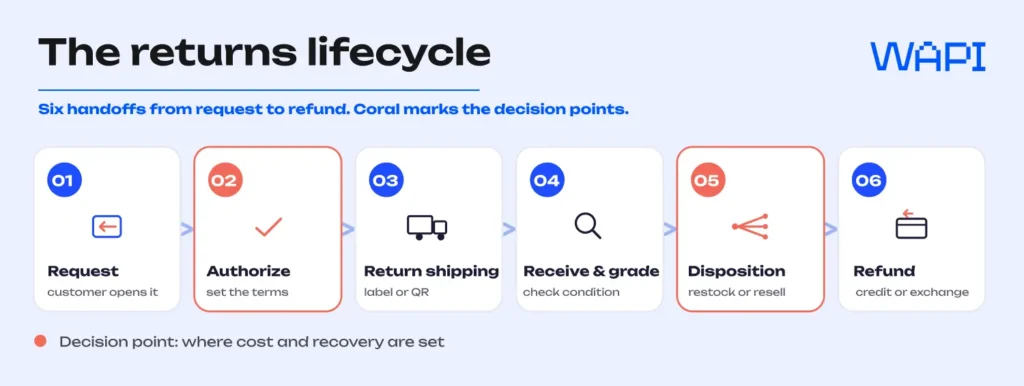
Break the returns process into its parts and the scope gets concrete. A customer requests a return. The system authorizes it and sets the terms. The item ships back, usually on a label you paid for. A warehouse receives it, inspects it, and grades its condition. Someone decides the item’s fate: restock, refurbish, liquidate, donate, or dispose. Finally the refund, store credit, or exchange clears. Each of those steps has a cost, a time window, and a customer watching.
Key point: The returns process is not one event. It is a sequence of six handoffs, and revenue leaks at every seam. Most teams optimize the refund and ignore the grading and restock steps, which is where speed actually converts into recovered cash.
Why returns stopped being a back-office cost
Returns used to sit with operations and finance, counted as shrinkage and shipping waste. Two shifts moved them to the front of the business. The first is volume. The second is that returns now shape customer satisfaction, customer loyalty, and the overall customer experience, because customers judge a brand by how it takes things back.
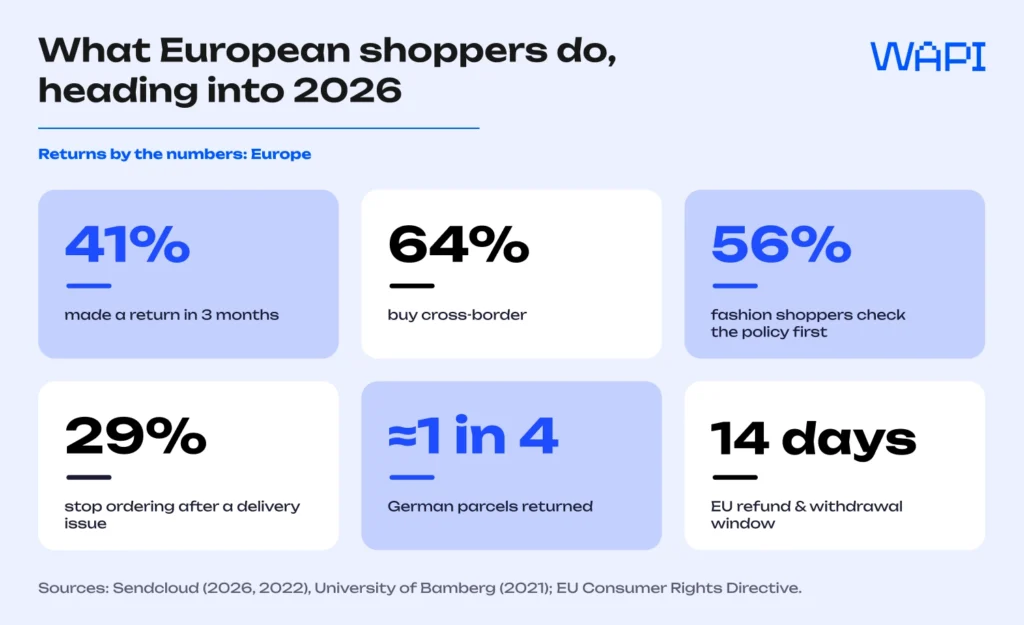
The behavioral data is hard to argue with. Sendcloud’s 2026 Delivery Compass, a survey of 8,000 European shoppers, found that 29% stopped ordering from a store after a delivery issue, while 64% bought cross-border in the previous six months. Earlier Sendcloud research found that 56% of fashion shoppers checked the return policy before purchasing, which turns a post-purchase document into a pre-purchase sales tool. A clumsy return does not just cost you one order. It costs the next one and damages the brand reputation that drives the one after that.
Fashion drives much of this. Bracketing, ordering several sizes or colors intending to keep one, has gone mainstream, and a 2019 Sendcloud study reported that 58% of online shoppers tended to return fashion items. Apparel also carries some of the highest return rates of any category, and Germany, the EU’s highest-returning market, shows the pattern most clearly. For these customers the returns experience is part of the buying experience. Friction there reads as friction with the whole brand.
| Returns by the numbers (Europe) | Figure | Source |
|---|---|---|
| Shoppers who returned an order in 3 months | 41% | Sendcloud Delivery Compass, 2026 |
| Shoppers who buy cross-border | 64% | Sendcloud Delivery Compass, 2026 |
| Fashion shoppers who check the policy first | 56% | Sendcloud, 2022 |
| Stop ordering after a delivery issue | 29% | Sendcloud Delivery Compass, 2026 |
| German parcels returned | Almost 1 in 4 (2021) | Uni Bamberg |
| German fashion return rate | Almost 34% (2022) | Retailer survey via Statista |
| EU withdrawal (cooling-off) period | 14 days from delivery | EU Consumer Rights Directive |
| Refund after a withdrawal notice | Within 14 days | EU Consumer Rights Directive |
Insight: Read those rows together and returns stop looking like a cost center. The same process drives customer satisfaction and customer loyalty across the whole customer journey: acquisition (the policy people read before buying), conversion (the confidence to click “buy”), and retention (whether they come back). Few line items shape the customer experience that widely.
The European layer most playbooks skip
Returns advice written for the U.S. assumes returns are a commercial choice. In the European Union they are partly a legal obligation, and selling across the bloc means building that obligation into your returns management process from the start.
Under the EU Consumer Rights Directive (2011/83/EU), a consumer who buys online has 14 days from delivery to withdraw from the purchase without giving any reason, the so-called cooling-off period. If you fail to tell customers about that right, the window does not quietly close; it extends by up to 12 months, which in practice can mean a withdrawal period of 12 months and 14 days. For change-of-mind returns the customer usually pays return shipping, but only if you informed them of that cost before they ordered. Once the customer notifies you of the withdrawal, you must reimburse them without undue delay and no later than 14 days. For goods, you may withhold the refund until you receive the items back or the customer provides proof of dispatch, whichever comes first. The reimbursement must also cover the original standard delivery cost, although you do not have to refund any premium the customer paid for express or another more expensive delivery option.
Defective or non-conforming goods sit on a separate legal track. Under EU consumer guarantee rules, consumers have a minimum two-year legal guarantee, and remedies may include repair, replacement, price reduction, or refund. Where a defective product has to be returned, the return cost is generally the trader’s responsibility.
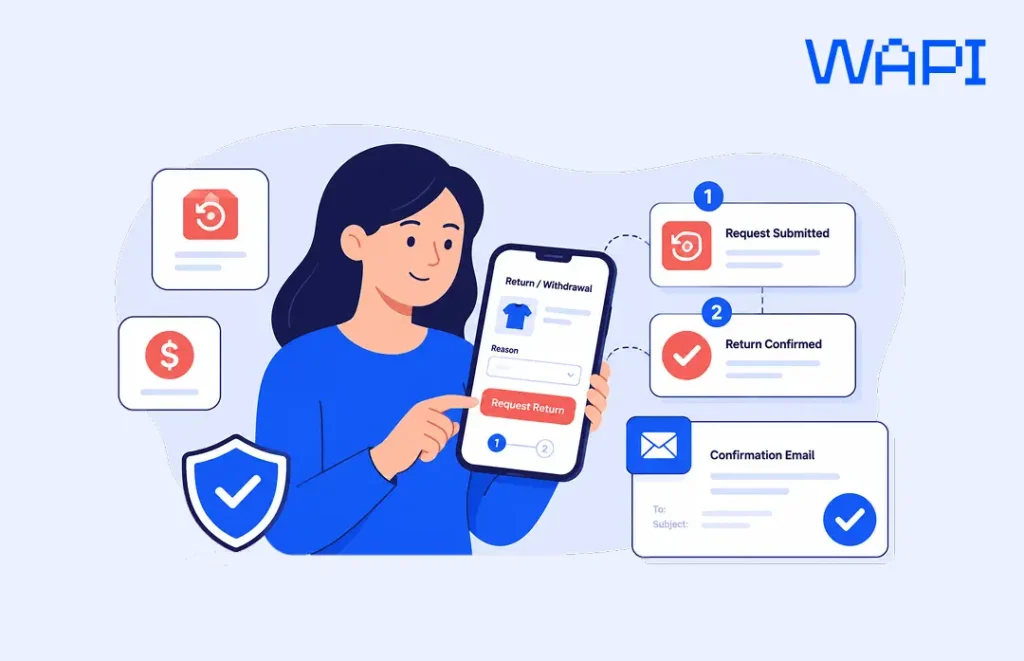
A newer rule sharpens the operational stakes. Directive (EU) 2023/2673, which amends the Consumer Rights Directive, requires traders to give consumers an easy-to-find electronic “withdrawal function,” often called a withdrawal button, for online B2C distance contracts that carry a statutory right of withdrawal, with a two-step confirmation flow and an acknowledgment on a durable medium. EU Member States were required to apply their implementing measures from 19 June 2026, and it does not extend to contracts with no withdrawal right, such as bespoke or perishable goods. A missing or faulty withdrawal function is its own compliance risk, with fines and enforcement in some member states. It is separate from the point above: the button itself does not lengthen the statutory withdrawal period, but failing to properly inform consumers of their right can extend that period by up to 12 months. The withdrawal route has to be prominent, easy to access, and available throughout the withdrawal period, which makes the returns portal and refund workflow part of compliance infrastructure rather than a purely operational feature.
In practice, a compliant withdrawal flow does a few concrete things:
- Display the withdrawal function throughout the withdrawal period, not only at checkout.
- Collect only the identification details the request actually needs.
- Include a clear confirmation step before the request is submitted.
- Send an acknowledgment on a durable medium, such as email.
- Preserve records of each request in case of a dispute.
Our advice: If you sell into the EU, audit your returns flow against the June 2026 withdrawal-button requirement now rather than after a complaint. Treat the button as the visible tip of a system: a clear policy, a working portal, refund processing inside the 14-day window, and clean records. Compliance and a good returns experience are the same project, not competing ones.
Logistics adds a second European wrinkle. A return that has to travel back across a border is slow and expensive, and cross-border return shipping can erase the margin on the original sale. The cleanest fix is structural: process returns close to where the customer is, at a local node, so an item re-enters sellable inventory in days rather than weeks.
A return policy customers read before they buy
Since most shoppers read the policy before purchase, write it for that reader, not for your warranty lawyer. Plain language, specific numbers, no buried conditions. State the return window, who pays return shipping, the condition you expect items to come back in, and what the customer gets: a refund, store credit, or an exchange.
A strong return policy answers these without making anyone hunt:
- The return window in days, and when the clock starts.
- Who pays for return shipping, and any exceptions for defective items.
- Whether refunds go to the original payment method, to store credit, or both.
- Which categories carry restrictions, such as sealed health and hygiene goods.
- How a customer starts a return, and how long the refund takes once you receive the item.
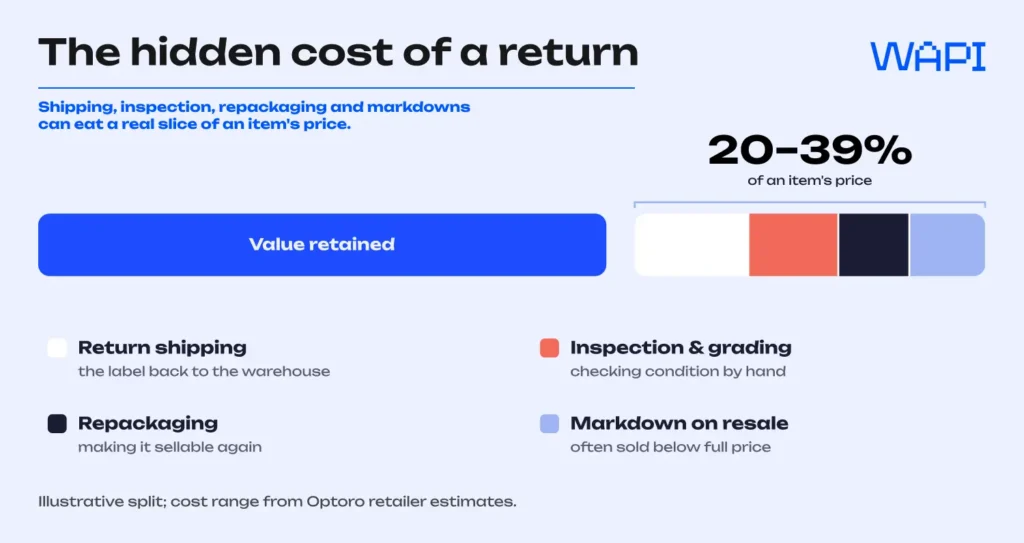
Free returns deserve a harder look than they usually get. Customers clearly want them, yet processing a return can consume a material share of an item’s price once you count return shipping, inspection, repackaging, and markdowns on resale, on the order of 20% to 39%, according to retailer estimates cited by Optoro. Norms vary sharply by market: a University of Bamberg study found nearly 89% of German retailers offer free returns against about half elsewhere in the EU, one reason German return rates lead the continent, and paid returns are now a rising trend across European fashion. The right answer varies by margin and category. High-margin apparel can often absorb free returns and use them to build customer loyalty and repeat purchases. Thin-margin or bulky goods may need a return-shipping fee, an extended return window in exchange for store credit, or free returns only above a basket threshold. Calibrate the policy to the unit economics rather than copying a competitor.
Key point: A return policy is both a customer-service promise and a margin decision. Every clause, the window, the shipping fee, refund versus store credit, moves both conversion and cost. Set it with the finance team in the room, not after.
The self-service returns portal
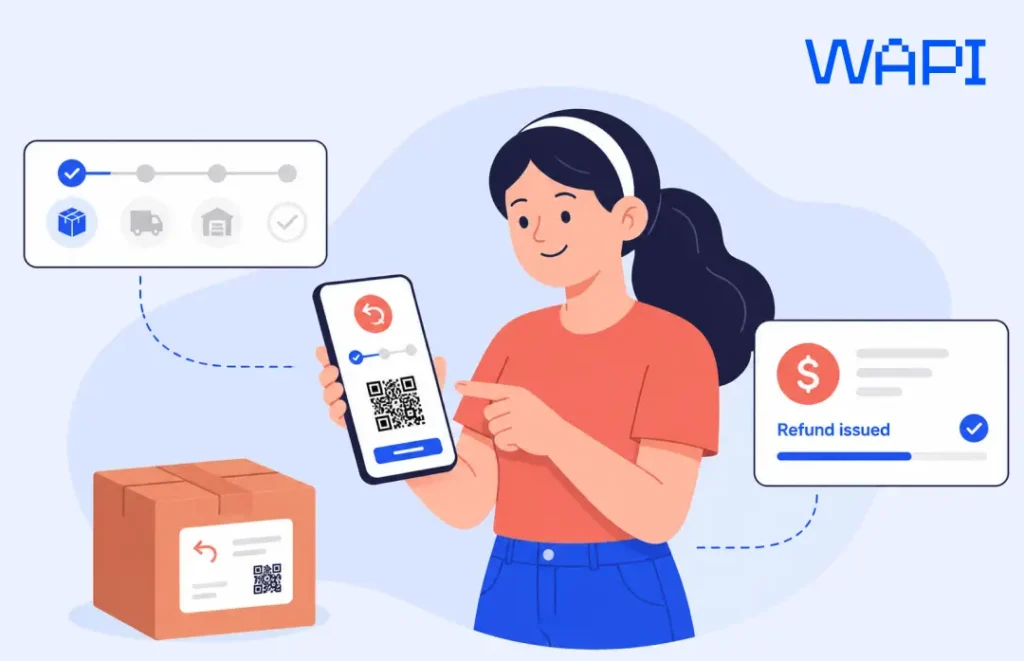
A self-service returns portal is the difference between a return that runs itself and a return that lands in your support queue. Instead of emailing for a label and waiting, the customer opens a self-service returns portal, selects the item and reason, and gets a label or a QR code on the spot. The mechanics that used to consume support tickets become a two-minute task the customer completes alone.
The portal earns its keep three ways. It removes volume from the customer service team, so agents handle judgment calls instead of label requests. It protects customer satisfaction by setting clear expectations, showing refund timing and status so customers stop asking, “Where is my refund?” And it captures structured returns data, because the customer tells you the reason in a dropdown rather than a free-text complaint nobody reads.
An exchange-first flow can protect revenue without hiding the refund option. If the customer needs another size, color, or variant, the portal should make that path faster than a refund while still keeping the refund route clear and compliant. The goal is not to trap the customer in store credit, but to remove friction when the customer still wants the product.
Returns management software: native tools vs dedicated platforms
Ecommerce returns software ranges from what your store platform already includes to dedicated returns platforms that bolt on top, to returns workflows built into a fulfillment provider’s system. The right choice depends on volume, channel count, and how much of the reverse logistics you run yourself.
Three broad options, with honest trade-offs:
| Option | Best for | Strengths | Limits |
|---|---|---|---|
| Platform-native returns | Single-store sellers, lower volume | No extra cost, native to checkout and orders | Basic rules, limited analytics and multi-channel reach |
| Dedicated returns software | Growing brands, high return volume | Self-service portal, exchanges, store-credit logic, returns data | Added cost and another integration to maintain |
| 3PL-integrated returns | Cross-border and multi-market sellers | Returns tied to physical restocking and inventory | Tied to that provider’s network and footprint |
Shopify returns management
Shopify returns management has matured from a manual chore into a usable native workflow. Merchants can configure return rules, return windows, restocking fees, and final-sale items, and let customers file self-service returns from their account. Outside the US, merchants typically upload a carrier label or a label URL, since Shopify-created return labels are currently limited to eligible US returns. For brands that outgrow the native tools, the Shopify app ecosystem adds depth: platforms such as Loop and AfterShip layer in exchange-first flows, store-credit incentives, and richer returns analytics. The practical rule is to start native, then add a dedicated app once return volume or exchange complexity justifies the cost.
Magento returns management
Magento returns management centers on RMA, return merchandise authorization, which is built into Adobe Commerce rather than Magento Open Source. RMA lets customers request returns from their account, gives admins a workflow to approve, track, and resolve them, and ties returns to order records. Open Source merchants typically add an RMA extension or a third-party returns platform to reach the same functionality. Magento’s strength is configurability for complex catalogs and B2B rules; the cost is that you, or your developer, own more of the setup than you would on a hosted platform.
Insight: Returns management software does not reduce returns by itself. It reduces the cost and friction of the returns you already get, and it surfaces the data that lets you cut future returns. Buy it to lower handling cost and to see clearly, not as a magic return-rate fix.
Reverse logistics: where the margin is won or lost
Reverse logistics is the physical half of ecommerce returns management, and it is where most of the money is quietly lost. Forward logistics moves predictable cartons out the door. Reverse logistics handles one-off items in unknown condition that each need a human decision. The cost per unit is higher, and the work competes for the same warehouse space, labor, and dock doors as your outbound orders.
That competition is not hypothetical. When returns spike after a sale or over the holidays, they fight for the same dock doors, labor, and shelf space as outbound orders, and fulfillment slows, which is a brutal trade for any growing store. Post-holiday returns typically peak in January, and many retailers lean on third-party logistics partners to absorb the surge rather than staff up for a few weeks. For cross-border sellers the squeeze is worse, because a return that has to clear a border adds days and cost before the item is even assessed.
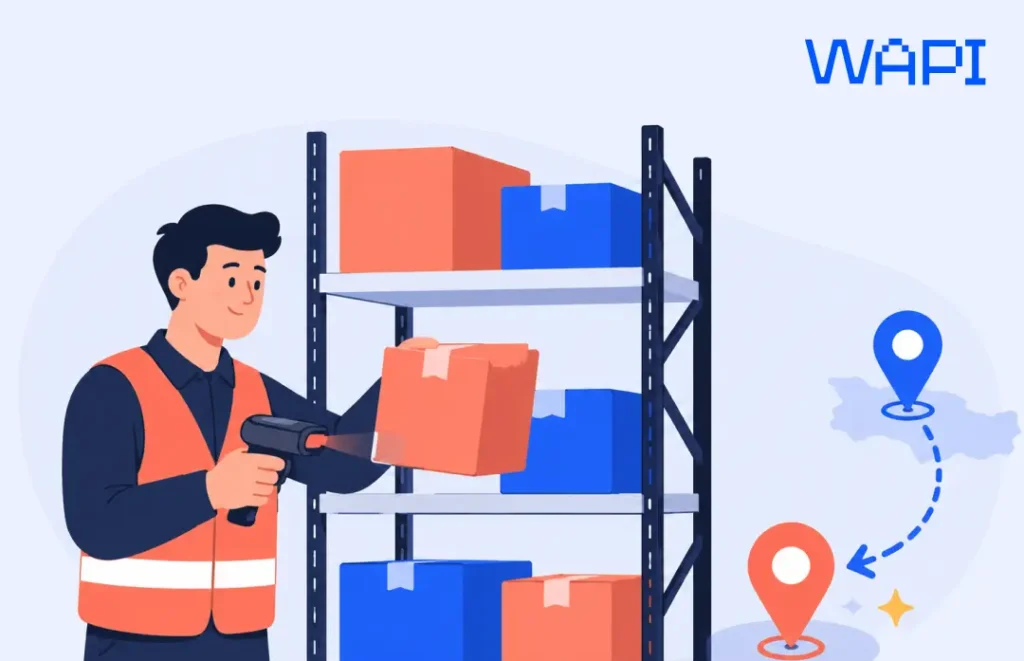
Speed is the lever that turns reverse logistics from a cost into recovery. An item sitting in a returns queue is stranded capital: you have paid for it, and it earns nothing until it is graded and put back into sellable inventory. The faster the disposition decision, the more revenue you retain rather than write off. Sustainability rides along with that speed. Returns carry a real carbon cost: a University of Bamberg study estimated that returns in Germany generated around 795,000 tons of CO2 in one year, so returns that restock or refurbish quickly, rather than heading to disposal, protect margin and cut waste at the same time.
Our advice: Track time-to-restock as a primary returns KPI, not an afterthought. Every day an item waits in grading is a day of lost recovery and lost shelf availability. If your own warehouse cannot grade and restock returns within a few days during peak, that is the moment to move returns processing to a partner who can.
Turning returns data into fewer returns
Returns data is the most honest feedback your store collects, because customers vote with the item itself. Analyze returns data by reason and you stop guessing about quality and start fixing root causes. Sizing returns point to a fit chart that needs work. “Not as described” points to product descriptions or images that oversell. A spike on one SKU points to a quality-control problem upstream.

The categories matter as much as the totals. Fit and style issues are the biggest drivers of apparel returns. In McKinsey’s survey, retailers attributed 70% of returns to poor fit or style, so a high apparel return rate usually calls for better size guidance, fit tools, and more accurate product presentation, while damage-driven returns call for packaging changes. Detailed product descriptions, accurate photos, and honest reviews do more to lower returns than any policy tightening, and they do it without punishing the customers you want to keep. Tie the analysis back to the catalog and the returns process becomes a continuous product-improvement loop rather than a ledger of losses.
Category shapes the workflow, not just the reason codes. Apparel returns are often driven by fit and bracketing; electronics returns may involve condition checks and fraud risk; cosmetics and supplements raise stricter inspection and resale constraints. A useful returns workflow should reflect those category differences rather than applying one generic rule to every SKU.
For a broader framework that connects these steps, see WAPI’s guide to ecommerce returns optimization.
Key point: Ecommerce returns management is partly a reporting discipline. If you cannot see why items come back, broken down by reason and SKU, you are managing the symptom. The reason data is where the leverage to reduce returns actually lives.
Returns fraud, without punishing good customers
Returns fraud is a real and growing line item, and the hard part is fighting it without adding friction for honest buyers. It is hard to size precisely, and reliable European figures are scarce; in the US, Appriss Retail and Deloitte estimated that 15.14% of consumer returns were fraudulent in 2024. The tactics are familiar across markets: wardrobing (wearing an item once, then returning it), empty-box returns, and swapping a genuine product for a counterfeit. Wardrobing spikes around predictable moments: televisions are sent back after a big match, and party dresses return every January.
Technology helps, with limits. A growing number of retailers now use AI to flag suspicious returns, though the tools are still maturing and false positives are common. The lesson is to aim fraud prevention at the small group of bad actors rather than the whole customer base. Item verification at the point of return, return histories that flag genuine outliers, and rules that scale scrutiny to order value all catch abuse while letting normal returns run fast. Blanket friction, by contrast, taxes the honest majority and quietly pushes them toward competitors with easier returns.
Insight: Fraud controls and customer experience pull in opposite directions only if you treat all customers as suspects. Target the controls, and you protect revenue and the customer experience at the same time.
Measuring success: the KPIs that matter
You cannot improve what you do not measure, and returns reward a focused scorecard over a sprawling one. A handful of key performance indicators tell you whether your ecommerce returns management strategy is working.
Track these as your core returns KPIs:
- Return rate, overall and by category and SKU, watched as a trend rather than a single number.
- Return reason mix, so you can separate fixable returns (sizing, description) from inherent ones.
- Time-to-restock, the days from receipt to sellable inventory, your clearest recovery metric.
- Recovery rate, the share of returned value you recapture through restock, refurbishment, or resale.
- Repeat-purchase rate of customers who returned, which shows whether your returns experience builds customer loyalty or burns it.
That last metric is the one most teams never build, and it is the one that proves the thesis. If customers who return still come back and buy again, your returns process is doing its real job: protecting customer satisfaction and the relationship, not just the transaction.
For cross-border sellers, the operational question is not only what the policy says, but where the return physically goes. Processing returns at a local node, close to the customer, closes the loop between receipt, grading, and restock in days rather than the weeks a return trip across a border can cost, and it turns stranded inventory back into sellable stock while it still holds its value.
See how WAPI’s European network turns returns back into sellable stock →
Frequently asked questions
What is a good return rate for an ecommerce store?
There is no single benchmark; it depends on your category and market. In Germany, the EU’s highest-returning market, a University of Bamberg study found almost one in four ecommerce parcels was returned in 2021, and a 2022 retailer survey put the fashion return rate at almost 34%. Apparel and footwear run far above the average; electronics and consumables below. Track your own rate by category and market over time rather than chasing a cross-border average.
Should I offer free returns?
Not automatically. Free returns matter to European shoppers, but processing a return can eat a meaningful share of an item’s price once shipping, inspection, and resale markdowns are counted, on the order of 20% to 39%, according to retailer estimates cited by Optoro. Norms vary by market, from nearly universal free returns in Germany to paid returns spreading across European fashion. Offer free returns where margins and repeat-purchase value support it, and use alternatives elsewhere: a return-shipping fee, free returns above a basket threshold, or store credit in exchange for a longer return window.
How do I reduce ecommerce returns without hurting sales?
Fix the causes, not the policy. Most avoidable returns trace to fit, expectations, or damage, so sizing tools, detailed product descriptions, honest photos and reviews, and better packaging cut returns without restricting customer rights. Analyze your returns data by reason and SKU to find where the volume comes from, then fix those products. Tightening the policy reduces returns and repeat customers together, which is rarely the trade you want.
What’s the difference between a refund and store credit, and which should I offer?
A refund returns money to the original payment method; store credit keeps the value in your store. Credit and exchanges protect revenue and can lift repeat purchases, which is why many brands lead with an exchange-first flow. You may offer store credit or an exchange, but for a statutory EU withdrawal the refund must normally go back through the original payment method unless the customer expressly agrees otherwise.
How long do I legally have to accept returns in the EU?
For online sales, the EU Consumer Rights Directive gives consumers 14 days from delivery to withdraw without a reason, and you must reimburse the customer within 14 days of being told they are withdrawing, though for goods you can withhold the refund until you receive the items back or proof they were dispatched. Defective goods carry a separate two-year guarantee of conformity. EU Member States were required to apply Directive 2023/2673 from 19 June 2026, adding an electronic withdrawal function on the online interface used to conclude the contract. The UK runs a parallel regime, with a 14-day distance-selling cancellation right and a 30-day right to reject faulty goods under the Consumer Rights Act 2015 (GOV.UK).
What is reverse logistics and why does it cost so much?
Reverse logistics is the physical handling of returned items: collection, transport back, inspection, grading, and the decision to restock, refurbish, resell, or dispose. It costs more than outbound shipping because every item is a one-off in unknown condition that needs a human decision, and it competes with new orders for the same warehouse capacity. Speed is the main cost lever; the faster a returned item is graded and restocked, the more of its value you recover.
Do returns management software tools integrate with Shopify and Magento?
Yes. Shopify offers native self-service returns and configurable return rules, plus dedicated apps such as Loop and AfterShip for exchanges and analytics. Magento, specifically Adobe Commerce, includes built-in RMA functionality, while Magento Open Source typically uses an RMA extension or a third-party platform. Most dedicated returns platforms and many fulfillment providers connect to both, so returns sync with your orders and inventory rather than living in a separate spreadsheet.
Does WAPI handle returns management as part of fulfillment?
Yes. Return management is built into WAPI’s all-in-one fulfillment system alongside multi-country inventory control, order rerouting, and order tracking, so returns are handled in the same dashboard as outbound orders. Returned items are processed at local warehouses within WAPI’s network of 16-plus facilities across the EU, UK, and Mexico, and the system integrates with Shopify, eBay, and BigCommerce so returns flow back into your stock without manual reconciliation across channels.
How does WAPI manage returns and exchanges for cash-on-delivery (COD) orders?
WAPI supports COD returns and exchanges as part of its fulfillment workflow, including the operational steps around failed delivery, return-to-sender flows, and seller and customer communication. Because COD carries a delivery-refusal risk that creates return costs, WAPI works to minimize refusals up front through SMS notifications, two or more delivery attempts, courier payment verification, and real-time tracking. WAPI handles COD across 19 markets in Europe and Mexico, with particular strength in central and eastern Europe, where it remains a common payment preference for trust-sensitive categories like supplements and cosmetics.
Where does WAPI process cross-border returns?
At a local node rather than back across a border. WAPI runs 16-plus warehouses across the EU, UK, and Mexico, including Germany, Slovakia, Spain, Poland, Italy, and Romania, so a returned item re-enters sellable inventory near the customer instead of making a slow, costly international trip. With 24- to 48-hour local delivery and warehousing positioned by market, this restocks returned goods faster and cuts the return-shipping cost that erodes margin on cross-border sales.

Keep in touch with WAPI!
Get free ecommerce tips, news, webinars and other stuff.
 Community