
 back to list
Most European rollout plans use Poland as a warehouse, not a market. Ship the pan-EU stock from a low-cost Polish facility, serve Germany and the Czech Republic the next day, and leave Polish shoppers as something to localize later. That plan quietly skips the largest ecommerce market in Central and Eastern Europe.
Poland is the biggest online market in the region, roughly 78% of internet users already buy online (Gemius, 2025), and the country runs the densest parcel-locker network in Europe. It also runs on habits a Northern European checkout does not speak: BLIK for payment, a locker for delivery, Allegro for discovery. In 2026 the opportunity is no longer to route European orders through Poland. It is to localize the offer for the Poland you have been shipping past.
This guide is the practical view for any brand weighing entry or expansion into ecommerce in Poland: real market size, who buys, the payments and delivery to design for, and the logistics that decide whether a cross-border launch clears margin or eats it.

Polish Ecommerce Market: Size and Growth Heading into 2026
How big is the Polish ecommerce market really?
This is the section where sources disagree, and the disagreement changes your planning numbers. Anchor on the local read. Strategy& valued Polish ecommerce at approximately PLN 140 billion in 2024 and forecasts the market to reach PLN 192 billion by 2028, an average annual rate near 8% (Strategy&). That trajectory implies a 2025 value of roughly PLN 150 to 152 billion, which should be treated as an estimate rather than a final reported total. The Central Statistical Office points the same way, with online retail sales up 9.4% year on year in January 2025 (GUS).
For a brand shipping boxes to Polish doorsteps, the total-turnover figure is the headline, not the plannable number. The B2C goods subset in dollar terms lands around $32 to $36 billion in 2025, ranging from approximately $32.3 billion in the Balkan eCommerce Summit dataset to $36.4 billion in the ResearchAndMarkets databook. That is the figure to size inventory and demand against.
| Source | Figure | Scope | Best used for |
|---|---|---|---|
| Strategy& / GUS | ~PLN 140B (2024 actual); ~PLN 150–152B (2025 estimate); PLN 192B by 2028 (forecast) | Total market turnover | The figure Polish trade press anchors on |
| ResearchAndMarkets (Databook Q4 2025) | $36.4B in 2025 to $51.39B by 2029 (9% CAGR) | Total ecommerce GMV | Forward-looking planning |
| Mordor Intelligence | ~7.6% CAGR through 2031 | Narrower B2C definition | Retail-only benchmarking |
| Balkan eCommerce Summit | ~$32.3B in 2025 (up from ~$25B in 2024) | B2C goods | Channel-mix context |
The methodologies measure different baskets, so the absolute numbers never line up. They agree on the shape: Poland is the biggest online market in the region, it grew fast for a decade, and it is now settling into a steadier climb.
Poland ecommerce statistics: pace, trajectory, and a maturity signal
Here is where Poland diverges from its neighbors. The market compounded at roughly 17% a year from 2020 to 2024. That pace has cooled. Forecasters now model high single digits through the end of the decade, and the operators on the ground read it the same way. In November 2025, InPost’s chief executive told investors he expected Polish ecommerce to grow no more than about 5% in the fourth quarter (InPost, Nov 2025). Allegro closed 2025 with Polish GMV up 9.4% for the year, while flagging November demand slowing to low single digits (Allegro, Q4 2025).
Read that as a feature, not a warning. Poland grew up first. Romania and other Central and Eastern European markets still post double-digit gains because they started from a thinner base, a story covered in the Romania ecommerce market guide. Poland already crossed the line where most people shop online by default, so the growth now comes from frequency and basket size rather than a wave of first-time buyers. Retail sales across the wider economy are growing around 4% to 5% (GUS), and ecommerce still runs ahead of that.
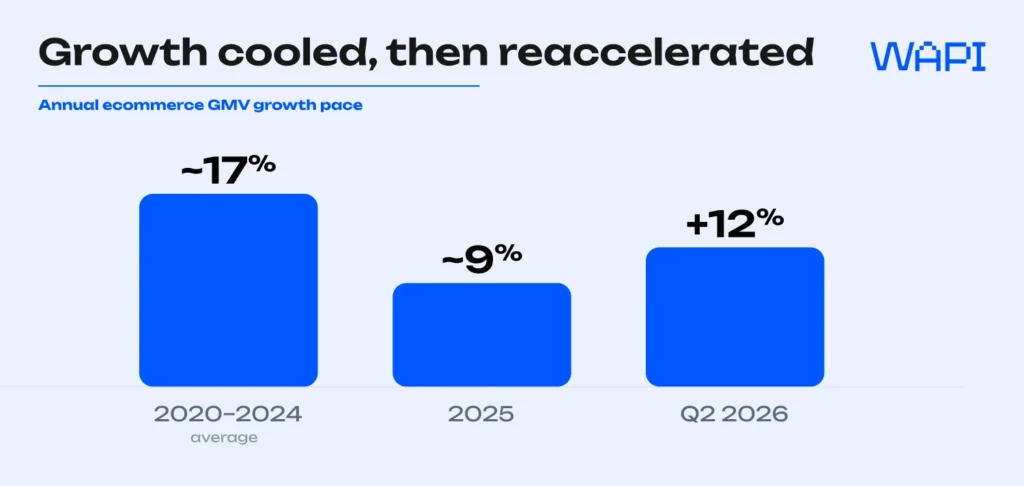
Key point: A maturing market rewards operators over land-grabbers. In Poland the easy years are behind, and the winners are the brands whose checkout speaks BLIK, whose delivery defaults to a locker, and whose returns clear inside the country. Execution quality, not a flashy launch promise, decides the P&L here.
Who Shops Online in Poland?
Poland counted 34.1 million internet users at the end of 2025, an online penetration of 89.8% of the population, with 53.8 million active mobile connections (DataReportal, Digital 2026). The internet base has essentially stopped growing; it dipped slightly year on year as the country reached saturation. Around 78% of internet users bought something online in 2025 (Gemius, 2025), a maturity level that rivals Western Europe, while 54.7% of internet users aged 16 and above reported buying a product or service online every week (DataReportal, Digital 2025 Poland).
The buyer base now spans every age group, not just the young and urban. Under-35s drive the newest habits, from BLIK to buy-now-pay-later, while older shoppers moved online in the last few years as lockers and mobile banking removed the friction. Behavior splits along familiar lines: women reach for BLIK more often, and men over-index on cash on delivery and installments (Gemius, 2025). Polish shoppers are price-sensitive and cross-border-curious, and they buy fashion and everyday goods most often, with electronics and beauty close behind. The demographic story is not a rush of new buyers anymore. It is existing shoppers moving more of their spending online and ordering more often. Average monthly online spend runs near $339, close to the European average, on an average order value around $76 (Balkan eCommerce Summit).

Warsaw and the demand geography
Order density concentrates around the metros. Warsaw and its surrounding Mazovia region anchor both supply and demand, with Kraków, Wrocław, the Tricity area, Poznań, and Łódź forming the second tier. The rural picture that still shapes markets like Romania barely applies here: Poland’s locker network already reaches small towns and villages, so the urban-rural delivery gap is narrower than almost anywhere else in the region. A Warsaw-anchored operation serves most of the value quickly, and the locker default handles the rest without expensive home-delivery attempts.
Features of the Polish Ecommerce Market
Mobile and BLIK own the checkout
Poland shops on its phone. With 53.8 million mobile connections against a population of 38 million, and the Allegro app as the country’s number-one shopping app, discovery and checkout both happen on the small screen. A checkout that needs a desktop or two-handed typing leaks conversion here. What makes it distinctive is BLIK, the domestic mobile-payment standard that turns a purchase into a six-digit code and a tap in the banking app. Polish shoppers reach for it first, and the payment section below covers why.
Allegro owns the value, and cross-border pressure is rising
Here is the feature that surprises sellers who only know Western Europe. Poland has a homegrown marketplace that dominates the way eMAG dominates Romania. Allegro accounted for an estimated 38.8% of Polish retail ecommerce sales in 2024 (Euromonitor, via Reuters), and its share of traffic to general marketplaces runs considerably higher. It counts around 15.5 million active Polish buyers as of Q1 2026, on group GMV that neared PLN 70 billion in 2025. Preliminary Q2 2026 results put Polish GMV growth at 12.0% year on year, showing further acceleration in the domestic business (Allegro, Q1 2026; preliminary Q2 2026). More than 70% of Poles associate the name with online shopping. Allegro also owns the machinery around the marketplace: Allegro Pay financed 16.1% of GMV in the first quarter of 2026, the Smart! program plays the Prime role, and Allegro Delivery routes parcels across more than 38,000 lockers and 37,000 pickup points, managing 45% of its own parcel volume (Allegro, Q1 2026).
Cross-border demand pulls the other way. The share of Polish internet users buying from foreign websites rose from 36% in 2024 to 41% in 2025 (Gemius, 2024–2025), with the traffic clustered on Temu, AliExpress, Amazon, and Shein. Temu’s reach is large but often overstated: OECD data puts it at an average of 10.5 million monthly unique web visitors and 6.4 million monthly active app users in Poland during 2025 (OECD), audiences that overlap and should not be added into a single user count. The biggest cross-border spenders sit on Temu and Amazon.
Two forces are reshaping that cross-border field right now. From 1 July 2026, the EU applies a temporary €3 customs duty to distance-sale consignments worth up to €150 imported from outside the bloc. The duty applies regardless of whether VAT is handled through IOSS, Special Arrangements, or the standard VAT procedure, and it is calculated per item category based on tariff classification, not per parcel or per unit (European Commission, 2026). The measure is separate from the proposed Union handling fee, whose amount and start date remain under discussion. The duty does not apply to individual consumer orders fulfilled from stock already customs-cleared and held inside the EU, which sharpens the case for local fulfillment. Alongside it, EU enforcement against major cross-border platforms has intensified. In May 2026, the European Commission fined Temu €200 million under the Digital Services Act for failures in assessing systemic risks linked to illegal products, while formal DSA proceedings against Shein, opened in February 2026, cover illegal products, addictive design, and recommender-system transparency. The read for a foreign brand: you compete with a vertically integrated home team on one side and the full global cross-border catalog on the other. Winning means matching local infrastructure, not out-spending it.
Top product categories in Polish ecommerce
- Fashion and footwear: the volume leader, with average monthly household spend above PLN 220 (Gemius, 2025). High return rates make a local return address the difference between a workable P&L and a leaky one.
- Electronics and home appliances: a historical engine with high order values, serious warranty and returns handling, and a Black Friday peak Poland treats seriously. The fulfillment job is serial-number tracking, secure packing, and surge capacity.
- Beauty and personal care: a strong cross-border pull, roughly PLN 139 of monthly household spend (Gemius, 2025), driven by influencer spikes. Batch and lot tracking plus the ability to absorb a campaign surge separate operators from amateurs.
- Health supplements and specialized goods: smaller in volume, but the category where handling beats price. Expiry-date control, batch traceability, and regulated-product paperwork turn into a real edge past a few hundred parcels a week.
- Home, garden, and hobby: a deep long tail that rides Allegro’s selection advantage and rewards accurate stock data over speed alone.
What Polish Consumers Expect
Polish buyers are pragmatic and spoiled by good logistics. They expect the delivery option they already trust, the price honest from the first screen, and a return that takes ten minutes at a locker two streets away. Lower delivery costs remain one of the strongest motivators for shopping online more often, and short delivery times, transparent product information, convenient payments, and clear returns terms also influence store choice (Gemius, 2025). Hidden costs that surface at the final step kill conversion the same way they do everywhere.
The defining expectation is the locker. In the 2024 Gemius survey, around 81% of Polish online shoppers named parcel lockers as a preferred delivery option, and 84% said convenient locker access makes them more likely to buy online at all (Gemius, 2024). The networks worth integrating at checkout:
- InPost Paczkomat: the giant, with roughly 29,000 automated parcel machines in Poland and the densest locker footprint in Europe (InPost). This is the default, and most sellers integrate it first.
- ORLEN Paczka: the second most recognized locker network, riding the fuel retailer’s national footprint.
- Allegro One Box: Allegro’s own lockers, wired straight into the country’s biggest marketplace.
- DPD Pickup and DHL: courier-run pickup and locker options that round out the mix.
- Same-day in the metros: available in Warsaw, Kraków, Wrocław, and other large cities through Allegro, quick-commerce apps, and grocery players.
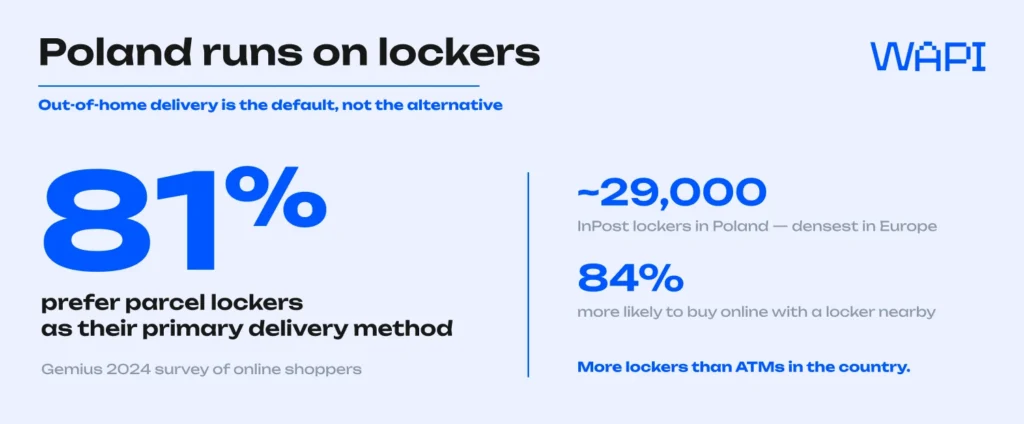
To put the density in perspective, InPost operates more parcel lockers in Poland than the country has ATMs, and about four times as many as it has petrol stations (InPost). Lockers stopped being a downgrade here years ago; they became the road.
Our advice: Do not try to win the basket by burying shipping cost or over-promising same-day nationwide. Polish shoppers want the locker they already use and the price shown up front. A reliable final-mile setup that hits its tracking events beats an aggressive cutoff that slips. Predictability earns the repeat order. One missed heroic promise earns a support ticket and a lost customer.
Payment Methods Polish Customers Actually Use
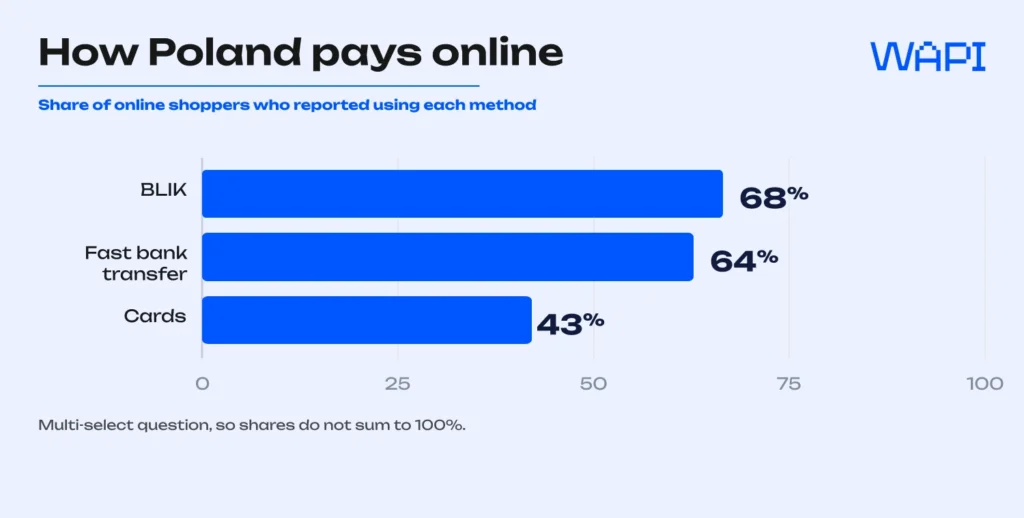
Read the Polish payment mix as a set of source-dependent signals. To keep the comparison honest, the table below uses one denominator where a comparable figure exists: the share of online shoppers who reported using each method (Gemius, 2024).
| Method | Share of online shoppers reporting use | Notable players | Role |
|---|---|---|---|
| BLIK | ~68% | Polski Standard Płatności | The default online rail, especially mobile and under 35 |
| Fast bank transfer (pay-by-link) | ~64% | Przelewy24, PayU, Tpay | The habitual second option |
| Cards | ~43% | Visa, Mastercard | Still common, slipping share online |
| BNPL / installments | No directly comparable share available | Allegro Pay, PayPo, Klarna, BLIK Pay Later | Growing fast, strongest for higher-ticket and under-35s |
| Cash on delivery (pobranie) | No directly comparable share available | Multi-courier | Narrower: trust-sensitive categories and first orders |
A card-only checkout looks foreign in Poland. The split between BLIK and instant bank transfer is partly academic for a merchant, because both settle in seconds from a bank app. What matters is offering the two methods Polish shoppers reach for first.
BLIK: the Polish payment no foreign checkout can skip
If Bizum is the Spanish payment story and cash on delivery is the Romanian one, BLIK is Poland’s. It closed 2025 with 2.9 billion transactions worth PLN 441.5 billion and 20.7 million active users, adding more than two million users in the year (BLIK, 2025). Ecommerce is its strongest channel, close to half of all BLIK activity, with the average online payment around PLN 158 (BLIK, 2025). In the 2024 Gemius survey, 68% of Polish online shoppers reported using BLIK, including 86% of shoppers aged 15–24 and 82% of those aged 25–34 (Gemius, 2024).
The practical lineup for a Polish checkout in 2026 is short and non-negotiable at the top:
- BLIK: the anchor for domestic baskets, especially mobile and under 40.
- Fast bank transfer (pay-by-link) through Przelewy24, PayU, or Tpay, the habitual second option.
- Cards with strong 3DS support for the buyers who still prefer them.
- BNPL and installments via Allegro Pay, PayPo, or Klarna for higher-ticket fashion and electronics.
- Cash on delivery where the category and buyer actually pull on it.
Insight: By transaction volume, Polish ecommerce runs on BLIK and instant transfers, yet cash on delivery still earns its place in a narrower set of situations. It performs best where buyer trust gates the sale, in categories like supplements, cosmetics, and consumer electronics, and on the first purchase from an unfamiliar brand at a higher price point. A partner that handles cash on delivery end to end, with clean collection, reconciliation, and real-time signals on refused or failed deliveries, turns pobranie from a margin drag into a conversion lever. The same setup carries across the wider region, where cash at the door still moves real volume.
Polish Logistics Realities
Poland’s last mile is fast, cheap, and dense by any European standard. The Warsaw-Kraków-Wrocław-Poznań corridor is served hard by InPost, DPD, DHL, GLS, and Poczta Polska, and the locker grid absorbs the volume that would otherwise fail on first home-delivery attempt. Delivery and logistics still run high as a share of the operating model, up to roughly 35% of ecommerce operating costs (Alsendo), which is exactly why routing and locker integration matter to margin.
Poland’s position also makes it the natural fulfillment base for the wider region. It is why Chinese platforms building out European delivery keep landing here: Alibaba’s Cainiao opened its third Polish warehouse on the back of triple-digit shipment growth, and it now supports two-to-three-day delivery across much of Europe from Polish soil. What foreign brands use Poland for as a shipping hub, the market itself has already built at scale.
The locker effect and last-mile consolidation
The locker market keeps consolidating. InPost leads by a wide margin, ORLEN Paczka and Allegro One Box compete for second, and courier pickup rounds out the field. For a seller, that points to a few deep carrier integrations rather than many shallow ones, and it makes locker-first checkout the baseline for both delivery and returns.
What to Set Up Before Shipping to Poland
Before launching or scaling into the Poland ecommerce market, have these five blocks in place:
- Carrier mix: at least one home-delivery courier plus locker integration through InPost, ORLEN Paczka, and Allegro One Box. Single-carrier setups tend to underperform, and lockers are where demand already sits.
- Payment setup: BLIK and fast bank transfer at minimum, cards with 3DS, BNPL for relevant categories, and cash on delivery where the buyer profile calls for it. A card-only checkout underperforms in Poland.
- Returns setup: a local or regional return address, fast inspection, and inventory recirculation, with locker drop-off as the default. Without it, fashion and beauty break above modest volumes.
- Compliance: Polish VAT handling through OSS or local registration, Polish-language product and label checks, and batch traceability for supplements and cosmetics.
- Category specifics: fashion returns workflows, cosmetics handling with batch tracking and restricted-shipping rules, and supplement documentation for the competent Polish authority.
Skip these and the failure mode is predictable. Returns pile up at a foreign warehouse, conversion slides on a checkout missing BLIK, and support tickets stack up over delivery that does not default to a locker. None of it shows in a market-sizing slide, which is exactly why it ambushes teams six months into a launch.
How Cross-Border Sellers Should Approach the Polish Market
Local fulfillment beats pan-EU once volume is real
For a low-volume test, a German warehouse handles Poland fine. But Poland pairs Western-European market maturity with fulfillment and labor costs well below Germany’s, so moving stock into the country buys reach and margin at once, not just cheaper storage. Based on WAPI’s operating experience across European markets, the economics tilt toward dedicated Polish fulfillment past a few hundred parcels a week: faster delivery, lower last-mile cost, a domestic returns address, and clean handling of BLIK-driven volume and any cash-on-delivery orders. WAPI runs exactly this from its warehouse in Poland in Grabica, with 24-hour delivery to major Polish cities and two-to-three-day shipping across the EU, plus the network to serve neighboring markets from the same stock.
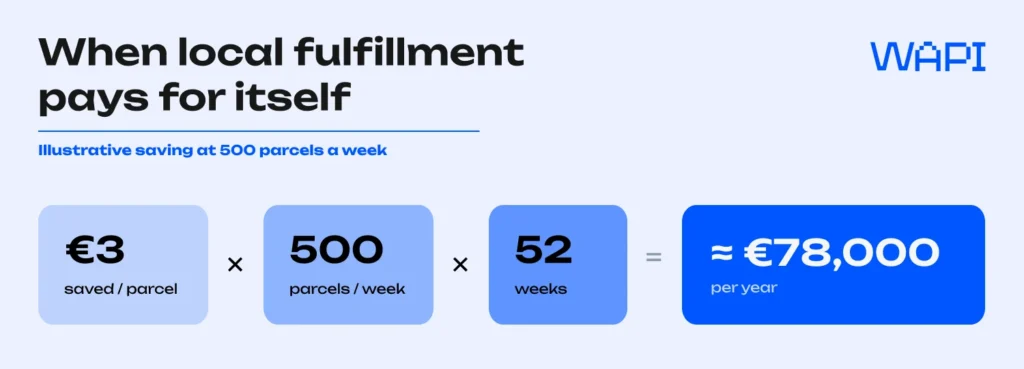
The arithmetic is blunt. A €3 saving per parcel on 500 parcels a week is roughly €78,000 a year, enough to fund the local switch and still come out ahead. The question for most cross-border brands is not whether to set up ecommerce fulfillment in Poland, but when.
As a practical WAPI benchmark rather than a universal threshold, these signals usually mean it is time to move stock into the country:
- Polish order volume holds at 300 or more parcels per week for two consecutive months.
- Return rate clears 25%, particularly in fashion or beauty.
- Support tickets spike on transit-time and tracking complaints.
- Paid acquisition efficiency drops because conversion bottlenecks on the delivery and payment promise.
- Redelivery and refused-order costs from a remote setup start visibly eroding margin per order.
Localize beyond translation, and layer Allegro with your own store
Polish-language product pages, Polish customer support, and Polish-language return instructions are table stakes. Real localization means pricing in złoty with VAT shown, putting BLIK and locker delivery front and center, and pacing delivery promises against Allegro rather than your home market. A translated template on top of an English store does not count as a market entry.
Allegro dominates discovery, so in WAPI’s experience the resilient play layers it on top of a localized store: sell through the marketplace for reach and trust, and run your own site for margin and customer data. Marketplace-only leaves you exposed to fee and algorithm shifts. Direct-only means slow, expensive acquisition in a market where the marketplace holds the audience. WAPI plugs into both sides directly: a native Allegro integration fulfills marketplace orders under Allegro’s delivery rules, the same stock ships a seller’s own store, and the Shopify integration lets shoppers pick a specific locker or pickup point at checkout, so one inventory pool serves every channel.
Final Take: Poland Is the Market You Are Already Shipping Through
Polish ecommerce has quietly become the anchor of Central and Eastern Europe: the largest market in the region, an internet base near saturation, the densest locker network on the continent, and a payment stack Western checkouts do not natively support. Growth has cooled from its pandemic-era pace as Poland matured first, even as preliminary Q2 2026 data from Allegro showed a renewed double-digit acceleration, and that maturity changes the game from land-grab to operations. The sharp edges (BLIK, lockers, Allegro’s gravity) are logistics-and-payments problems, not marketing ones.
Our advice: Treat Poland as an operations market, not a translation exercise. The brands that win in 2026 match their checkout, their locker coverage, and their returns to the bar InPost and Allegro set, and they stop treating the country as just the warehouse they ship the rest of Europe from. Build for how Poland actually buys, and the largest market in the region does the rest.
FAQ
How big is the Polish ecommerce market in 2025?
Polish ecommerce is estimated at roughly PLN 150 to 152 billion in 2025. That figure is extrapolated from Strategy&, which valued the market at about PLN 140 billion in 2024 and forecasts PLN 192 billion by 2028, so 2025 should be read as an estimate rather than a reported total. In dollar terms the B2C goods subset sits around $32 to $36 billion. Poland is the largest ecommerce market in Central and Eastern Europe, and the Central Statistical Office reported online retail sales up 9.4% year on year in January 2025.
Is the Polish ecommerce market still growing?
Yes, though the underlying pace has cooled from the roughly 17% annual growth seen in 2020–2024. Allegro closed 2025 with Polish GMV up 9.4%, while preliminary Q2 2026 results showed a reacceleration to 12.0% year on year. The longer-term outlook remains in the high single digits, with growth increasingly driven by order frequency and basket size rather than first-time online buyers.
What is the most popular online payment method in Poland?
BLIK, the domestic mobile-payment standard, is the default for online purchases. It handled 2.9 billion transactions across all channels in 2025, has 20.7 million active users, and draws close to half of its volume from ecommerce. In the 2024 Gemius survey, 68% of Polish online shoppers reported using BLIK, including 86% of 15-to-24-year-olds and 82% of 25-to-34-year-olds. Fast bank transfer through providers like Przelewy24 and PayU is the habitual second option (about 64% of shoppers), cards sit lower online (about 43%), and BNPL is growing quickly. A checkout for Polish customers should lead with BLIK and fast transfer.
Do Polish shoppers prefer parcel lockers or home delivery?
Lockers, decisively. In the 2024 Gemius survey, about 81% of Polish online shoppers named parcel lockers as a preferred delivery option, and 84% said convenient locker access makes them more likely to buy online. InPost’s Paczkomat network, with roughly 29,000 machines, is the densest in Europe and the default choice, followed by ORLEN Paczka and Allegro One Box. Offering locker delivery lifts completed orders and cuts redelivery costs, and locker drop-off is also the return method Polish shoppers prefer.
What are the biggest online marketplaces in Poland?
Allegro is the dominant marketplace, accounting for an estimated 38.8% of Polish retail ecommerce in 2024 (Euromonitor, via Reuters), with its share of marketplace traffic considerably higher. More than 70% of Poles associate the brand with online shopping, and it counted around 15.5 million active Polish buyers as of Q1 2026. It owns adjacent services including Allegro Pay, the Smart! loyalty program, and the Allegro One Box locker network. Among cross-border platforms, OECD data puts Temu at an average of 10.5 million monthly unique web visitors and 6.4 million monthly active app users in Poland during 2025, with AliExpress, Amazon, and Shein also active.
Do I need a Polish company to sell ecommerce in Poland?
Not for most cross-border setups. EU sellers can ship into Poland under the One-Stop Shop (OSS) VAT scheme from their home country, and non-EU sellers can use IOSS for consumer parcels under €150. One change to note: from 1 July 2026 the EU applies a temporary €3 customs duty to distance sales of goods worth up to €150 imported from outside the bloc, calculated per item category by tariff classification. It applies regardless of the VAT scheme, so using IOSS still handles VAT but no longer means zero customs cost, and goods fulfilled from stock already held inside the EU are not affected. A local entity is rarely required upfront; Polish-language labels and batch traceability for regulated categories matter more at launch.
Is cash on delivery still popular in Poland?
It is declining but far from gone. By transaction volume, Polish ecommerce runs on BLIK and instant bank transfers, yet cash on delivery (pobranie) remains a familiar and widely offered option. It performs best in trust-sensitive categories such as supplements, cosmetics, and consumer electronics, and on first purchases from unfamiliar brands at higher price points. Men over-index on it relative to women. For sellers reaching cautious or first-time buyers, offering it well can lift conversion.
Does WAPI have a warehouse in Poland, and how fast is delivery?
Yes. WAPI runs warehousing and fulfillment in Poland from a facility in Grabica, positioned for both domestic distribution and cross-border shipping. Orders reach major Polish cities within 24 hours and most EU destinations within two to three days. The Polish hub is part of a network of 16-plus warehouses across the EU and UK, and it opens fast access to neighboring markets including Czechia, Slovakia, and the Baltic states from the same stock.
Does WAPI offer cash on delivery in Poland?
Yes. Cash on delivery (pobranie) is one of WAPI’s core services, which suits Poland’s trust-sensitive categories well. WAPI handles it end to end, including collection through local couriers like DPD and InPost, reconciliation, and signals on trouble statuses such as failed or refused deliveries. On WAPI’s Polish operations, the buyout rate runs around 81% on an average order value near €120, cash settles from the courier within three to five days, and payouts are converted from złoty and paid out in euros. The same COD capability extends across WAPI’s wider European network.
What can WAPI store and handle in its Polish warehouse?
WAPI’s Polish warehouse handles consumer electronics, fashion and apparel, cosmetics and personal care, supplements and nutraceuticals, and general household goods, with secure storage and temperature-managed options for sensitive items. Value-added services include picking and packing, labeling, kitting and subscription-box assembly, fragile-item packaging, and returns processing, all tracked through WAPI’s warehouse management system with real-time inventory visibility. The setup integrates out of the box with Shopify, Allegro, eBay, BigCommerce, and Amazon, so orders from Poland’s dominant marketplace flow straight into fulfillment, and WAPI’s embedded customs handling supports cross-border trade in and out of Poland.
Sources and References
- Strategy&: Polish ecommerce ~PLN 140B in 2024 and PLN 192B forecast by 2028 (~8% CAGR); a ~PLN 150–152B value for 2025 is an extrapolated estimate — strategyand.pwc.com
- Central Statistical Office (GUS): retail sales dynamics, +9.4% YoY online retail in January 2025 — stat.gov.pl
- ResearchAndMarkets: Poland B2C Ecommerce Databook Q4 2025, $36.4B in 2025 to $51.39B by 2029, 9% CAGR — researchandmarkets.com
- Mordor Intelligence: Poland ecommerce market size and CAGR, BNPL and payment trends — mordorintelligence.com
- Balkan eCommerce Summit: ~$32.3B B2C goods estimate for 2025 (lower bound of the market-size range) — balkanecommerce.com
- DataReportal, Digital 2026 Poland: 34.1M internet users, 89.8% penetration, 53.8M mobile connections (data for end of 2025) — datareportal.com/reports/digital-2026-poland
- DataReportal, Digital 2025 Poland: 54.7% of internet users aged 16+ buying something online each week — datareportal.com/reports/digital-2025-poland
- Gemius / IAB Polska, E-commerce in Poland 2024: parcel-locker preferences and payment-method usage: 81% locker preference, 84% locker-driven purchase uplift, 36% cross-border shopping, BLIK 68% / fast transfer 64% / cards 43% — gemius.com
- Gemius / IAB Polska, E-commerce in Poland 2025: 78% ecommerce penetration, 41% cross-border shopping, category spending, mobile-shopping and demographic payment patterns — gemius.com
- BLIK / Polski Standard Płatności: 2.9B transactions in 2025, PLN 441.5B value, 20.7M active users, ~PLN 158 average online payment — blik.com
- InPost: ~29,000 APMs in Poland (Q1 2026), densest locker network in Europe — inpost.eu (Financial Results)
- Alsendo: parcel delivery and logistics costs as a share of ecommerce operating costs; parcel-locker adoption and convenience indicators — alsendo.com
- Allegro Q1 2026 results: ~15.5M Polish active buyers, 45% Allegro-managed parcel volume, Allegro Delivery 38,000+ lockers and 37,000+ pickup points, Allegro Pay 16.1% of Q1 GMV; group GMV neared PLN 70B in 2025 — about.allegro.eu
- Allegro preliminary Q2 2026 results: Polish GMV +12.0% YoY in Q2 2026; preliminary figures published 13 July 2026, with final Q2 results scheduled for 17 September 2026 — media.allegro.pl
- Euromonitor (via Reuters): Allegro ~38.8% of Polish retail ecommerce, end of 2024 — reuters.com
- OECD, Competition Market Study of Online Marketplaces in Poland, Latvia and Lithuania: Temu averaged approximately 10.53M monthly unique web visitors and 6.43M monthly active app users in Poland between January and December 2025 — oecd.org
- European Commission / Council of the EU (customs): temporary €3 customs duty per item category on sub-€150 distance sales from 1 July 2026 (political agreement December 2025; formal Council approval 11 February 2026; Commission implementing guidance 8 June 2026); applies across VAT schemes; separate Union handling fee with amount and date still to be set — taxation-customs.ec.europa.eu
- European Commission (Digital Services Act enforcement): €200M fine on Temu (28 May 2026) for inadequate systemic-risk assessment of illegal products; formal proceedings against Shein (17 February 2026) covering illegal products, addictive design, and recommender-system transparency — Temu decision · Shein proceedings
- WAPI, Warehouses in Poland: Grabica facility, delivery times, COD terms, courier network, value-added services — wapi.com/warehouses-poland

Keep in touch with WAPI!
Get free ecommerce tips, news, webinars and other stuff.
 Community