
 back to list

You’re running PPC. You’re getting traffic. You’re making sales.
But… your organic ranking won’t budge.
Your product sits on page 3, page 4, maybe page 7 — invisible to the millions of shoppers who never scroll past the first page. Every sale you make costs you ad spend, and the moment you pause your campaigns, sales drop.
Sounds familiar?
This is the reality for the majority of Amazon sellers. They’ve mastered PPC. They know how to drive paid traffic. But they’re stuck in a cycle where advertising costs keep rising, organic ranking stays flat, and profit margins slowly shrink.
Why is that? Because PPC alone was never designed to build organic ranking.
In this guide, we’ll show you a ranking strategy that works alongside your existing PPC campaigns to break through the page 1 barrier — one that most sellers have never heard of, let alone tried.
Why Organic Ranking Is So Hard to Crack
Before we get into the strategy, it’s worth understanding why organic ranking is such a struggle for most sellers — even those running solid PPC campaigns.
Amazon’s A9 algorithm decides where your product ranks organically. And at its core, the algorithm rewards one thing above everything else: sales velocity.
The more consistently your product sells for a specific keyword, the higher Amazon ranks it for that keyword.
To rank organically for a keyword, you need to be generating sales on that keyword. But to generate sales on a keyword, you need to be ranking for it.
It’s a chicken-and-egg problem. And for most sellers, PPC is the only tool they use to break the cycle.
What PPC Does (And Doesn’t Do) for Your Rankings
PPC is excellent at driving immediate traffic and sales. But here’s what most sellers don’t realize:
PPC sales DO contribute to your overall sales velocity. More sales = positive signal to Amazon’s algorithm.
BUT — PPC sales don’t carry the same organic ranking weight as organic keyword-matched sales. When a customer finds your product through a paid placement and buys it, Amazon registers the sale. When a customer searches a specific keyword organically, clicks your listing, and buys — Amazon registers both the keyword relevance AND the sale.
The second type of purchase is what moves you up the organic rankings. And that’s exactly what PPC alone can’t fully replicate at scale… So what can?
Introducing Product Testing Campaigns: The Ranking Strategy Most Sellers Overlook
Product Testing Campaigns are a structured ranking strategy where real testers — carefully selected to match your target audience — purchase your product on Amazon using specific keywords.
Think of it as mystery shopping, but designed specifically to improve your Amazon ranking.
Here’s the basic concept:
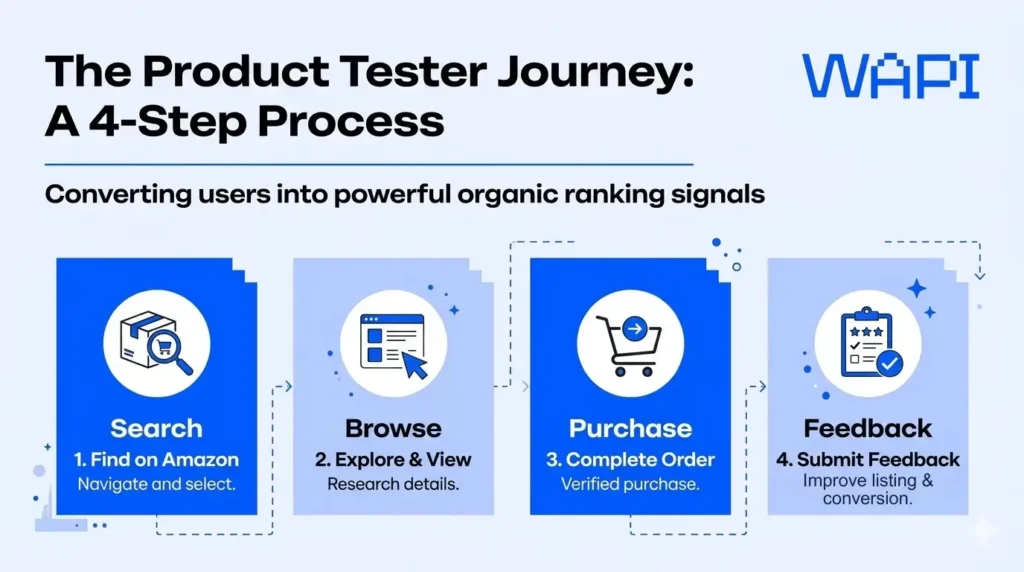
You identify the keywords you want to rank for. You recruit testers who match your ideal buyer profile. They go to Amazon, search for your product using those exact keywords, find your listing organically, and purchase.
Each purchase sends Amazon a clear signal: “This product is relevant and popular for this keyword.”
And when combined with your existing PPC data, it becomes precise.
Instead of guessing which keywords to target, you already know which ones convert. Your PPC campaigns have been telling you this for months — you just haven’t been using that data for ranking optimization.
The Combined Strategy: PPC + Product Testing Campaigns
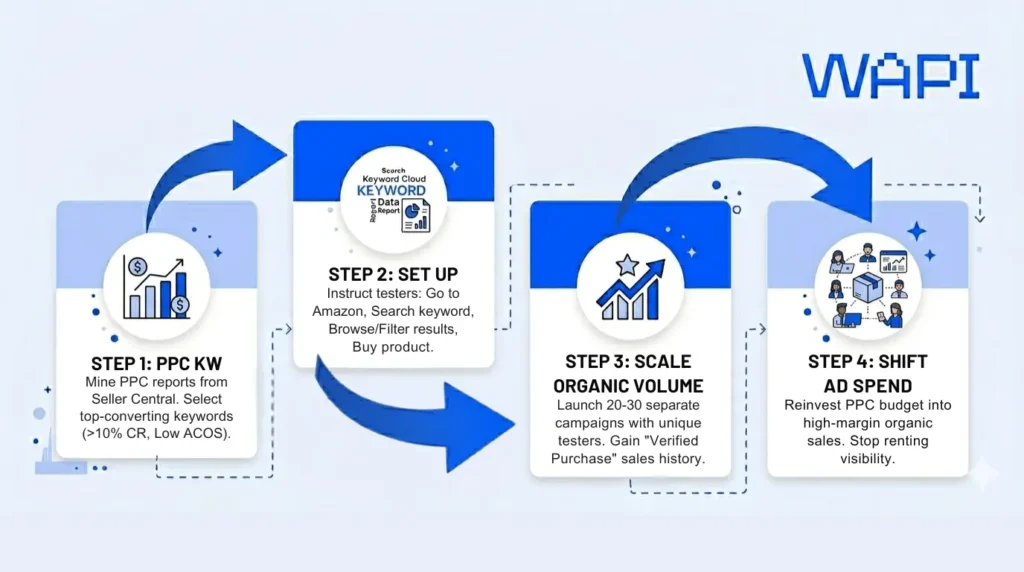
Here’s how the two strategies work together as one unified growth engine:
✅ PPC tells you WHAT works. Your Search Term Report shows you which keywords your customers actually use to find and buy your product. This is live market data — not keyword research guesswork.
✅ Product Testing builds RANKING on what works. You take those proven, high-converting keywords from your PPC data and use them to power your Product Testing Campaign. Testers search your product using these exact terms, creating the organic sales signal Amazon rewards.
The result? Your organic ranking improves on keywords that are already proven to drive sales.
Let’s walk through exactly how to implement this.
Step 1: Mine Your PPC Data for the Right Keywords
Before launching any Product Testing Campaign, you need to identify your highest-converting keywords. Your PPC campaigns are the fastest and most reliable source for this data.
How to find your best keywords:
- Log into Amazon Seller Central
- Go to Advertising > Campaign Manager > Reports
- Download your Search Term Report for the past 30–60 days
- Sort by conversion rate
What you’re looking for:
- Keywords with 5+ conversions and conversion rate above 10%
- Keywords where your ACoS is below your target
- Keywords where you’re NOT already ranking on page 1 organically
These are your gold targets. They convert when customers find you through paid ads — which means they’ll convert even better when customers find you organically.
Step 2: Set Up Your Product Testing Campaign
Now you’re ready to build a campaign that targets those specific keywords.
The number of testers depends on how far back you’re ranking and how competitive your category is. For example:
- Ranking page 6–10: 40–60 testers over 3–4 weeks
- Ranking page 3–6: 25–40 testers over 2–3 weeks
- Ranking page 2–3: 15–25 testers over 1–2 weeks
Just make sure you recruit the right testers. This is the most critical part of the entire strategy, because the wrong testers will not provide the most valuable feedback for your brand and listing.
Your ideal tester is a real Amazon shopper (active account, purchase history), demographically aligned with your target customer, and familiar with your product category.
Where to find them?
- Facebook groups related to your product category
- Instagram communities aligned with your product’s use case
- Niche forums and communities
- Your existing customers or followers
Instruct testers to use your exact PPC keywords to find and order your product. When testers purchase after searching your specific keyword, Amazon registers both the keyword relevance and the sale.
Step 3: Collect Feedback That Improves Your Entire Strategy
Product Testing Campaigns aren’t just a ranking tool. They are also a direct line to your customers’ honest opinions — something most sellers never get until it appears in a one-star review.
Design a feedback survey that covers:
Product quality:
- Does the product match what was described in the listing?
- What did you like most?
- What issues, if any, did you notice?
- What would you improve?
Listing clarity:
- Was the title clear and relevant to what you were searching for?
- Did the images accurately show the product?
- Were the bullet points helpful?
- Was the price fair for the quality?
This feedback matters beyond ranking, because the insights from your testers directly affect your PPC performance. A listing that converts at 12% generates 3x more sales from the same ad spend as one converting at 4%.
If testers tell you your main image doesn’t clearly show the product size — fix it. If they say your bullet points focus on features but not benefits — rewrite them. These improvements immediately lower your ACoS and improve the ROI of your entire PPC strategy.
Step 4: Monitor Your Ranking Progress
Track your organic position for each target keyword throughout the campaign using tools like Helium 10’s Keyword Tracker.
Results vary by category competition and baseline ranking. Highly competitive categories may require multiple testing rounds to break into page 1.
Step 5: Capitalize on Improved Rankings with Smarter PPC
Once your organic ranking improves, your entire PPC strategy gets more efficient.
When a keyword ranks on page 1 or 2 organically, add it to a dedicated exact match PPC campaign. So when customers search that term, they will see your sponsored ad at the top AND your organic listing on page 1. Double visibility for the same keyword dramatically increases your click-through rate and conversion probability.
As organic sales grow, they offset your paid acquisition costs — lowering your blended ACoS and protecting your margins.
Is This Strategy Right for You?
This combined approach works best if:
✅ You’re currently running PPC and have at least 30 days of Search Term data
✅ Your organic ranking is stuck on page 2-10 for your main keywords
✅ Your product has no major unresolved quality issues
✅ You’re ready to invest in a strategy that builds long-term, sustainable ranking
If you’re launching a brand new product with zero PPC history, start with 2-4 weeks of discovery campaigns first to build your keyword data, then implement this strategy.
Want to Know Exactly How This Would Work for Your Product?
You now understand the strategy. But applying it correctly — choosing the right keywords, recruiting the right testers, designing the feedback process, and connecting it back to your PPC optimization — requires expertise that comes from running hundreds of these campaigns.
That’s why intelliRANK offers a FREE 1-on-1 strategy session where they sit down with you and map out exactly how this combined strategy applies to your specific product and category.
Their team consists of Amazon growth experts who’ve helped sellers rank higher, spend less on ads, and build the kind of organic visibility that doesn’t disappear when you pause your campaigns.
If you want to put this strategy to work for your brand, intelliRANK’s team can handle everything — from PPC analysis to tester recruitment and ranking optimization.
👉 Book your FREE strategy call with intelliRANK!
Keep in touch with WAPI!
Get free ecommerce tips, news, webinars and other stuff.
 Community