
 back to list

Warehouse operations today face a convergence of pressures: skyrocketing order volumes, urgent delivery expectations, rising labor costs, and increasing competition among fulfillment providers. In this environment, traditional picking methods such as single order picking quickly reach their limits, especially in high-velocity ecommerce and retail operations.
Cluster picking is not just another picking method — it is an operational strategy designed to improve efficiency, accuracy, and scalability. This article explains what cluster picking is, how it works in a warehouse, why it matters in modern supply chains, and how it compares to other picking methods in practical settings.
What is cluster picking?
Cluster picking explained
Cluster picking is an order picking method where a warehouse worker gathers items for multiple orders in a single pass through the warehouse. Rather than processing one order at a time, cluster picking consolidates a set of orders into a cluster, optimizes the route through storage locations, and allows items to be sorted into order-specific containers during the picking run.
Why cluster picking matters in warehouse operations
Cluster picking is more than a technique — it is a response to a specific operational challenge: too much time spent walking and too little time spent picking. When warehouses deal with high flow, many small orders, or overlapping SKUs, traditional picking creates bottlenecks that require additional labor or automation. Cluster picking directly targets these inefficiencies.
EXPERIENCE NOTE: In fulfillment environments processing dozens or hundreds of orders per hour, teams often observe that once average order volumes exceed a certain threshold, single order picking adds up to more walking distance than pick accuracy. Cluster picking reduces that travel distance and increases throughput.
What do we mean by a “cluster”?
A cluster in this context is a group of orders selected for simultaneous picking because they share logical similarities — either in item overlap or proximity of storage locations. These orders do not need to be identical; rather, the grouping is done to reduce travel time and improve workflow efficiency.
KEY POINT: A cluster is not a random set of orders. It is created through a warehouse management system or strategy that assesses item locations, order profiles, and picker capacity.
Cluster picking in a warehouse: a practical example
Consider an ecommerce warehouse during a mid-week peak. Hundreds of small orders with overlapping SKUs are released for fulfillment. Instead of picking each order individually, the warehouse management system groups compatible orders into clusters. A picker receives a cluster pick assignment on their mobile device, follows an optimized pick path, and collects items for several orders in one journey.
Items are placed into designated bins on a picking cart, each bin corresponding to a different customer order. This approach eliminates the need for separate sorting later in the fulfillment process.
Main idea: in cluster picking, items are sorted into order-specific containers during picking, not after it.
Why warehouses choose cluster picking today
Reducing travel distance and unnecessary movement
Warehouse workers spend a significant portion of their time walking between storage locations. Cluster picking minimizes this by consolidating multiple orders into one picking trip — improving productivity without increasing labor.
Improving accuracy and blending sorting with picking
Immediate sorting into designated bins reduces the risk of mixing up orders. Pickers can verify items at the point of selection, leading to fewer mistakes later in the packing or shipping steps.
Supporting peak order volumes
Cluster picking allows warehouses to handle order volumes that would overwhelm traditional picking approaches. It scales without a proportional increase in labor.
EXPERT INSIGHT: Cluster picking becomes operationally preferable once order overlaps and SKU commonality exceed a certain level — often observed in B2C and high-velocity retail fulfillment.
How the cluster picking process works
Cluster picking is not a vague concept — it follows a structured workflow that integrates technology and warehouse planning.
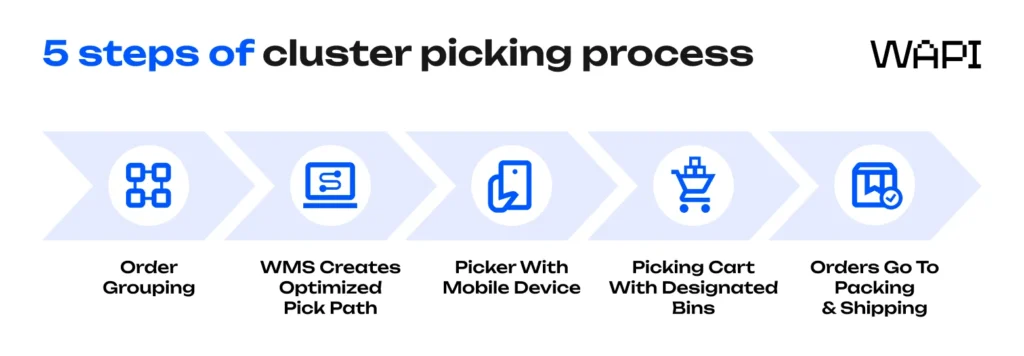
5 steps of cluster picking process
- Order grouping: Orders are grouped into clusters based on item locations, SKU overlap, and pick path potential.
- Path optimization: A warehouse management system (WMS) generates an optimized pick path to minimize travel time.
- Picking work: Warehouse workers follow the optimized route, using handheld devices or mobile scanners to confirm picks.
- Immediate sorting: Items are placed in designated bins, eliminating the need for later sorting.
- Order processing: Completed clusters move directly into packing and shipping.
EFFICIENCY INSIGHT: The real gains in cluster picking come not from grouping alone, but from how effectively the pick path aligns with inventory layout and order structure.
Physical setup: carts, bins, and warehouse layout
Picking carts and designated bins
Cluster picking requires specialized picking carts with multiple bins. Each bin corresponds to an order, and pickers place items immediately into the correct bin.
Layout and item placement
Storage locations should be structured to support logical pick paths. Frequently picked items should be placed in prime locations to reduce travel distance.
OPERATIONAL TIP: Even with the best WMS, suboptimal warehouse layout significantly reduces cluster picking performance.
Technology that enables cluster picking
Warehouse Management System (WMS)
A robust warehouse management system is critical — it manages order processing, inventory data, location directives, and pick path creation. Without this, cluster picking cannot scale.
Mobile devices and real time tracking
Modern cluster picking relies on fulfillment software that connects mobile devices, barcode scanning, and real-time tracking into a single operational flow. Handheld mobile devices guide pickers through the cluster picking process, display optimized pick sequences, and enable barcode scanning for correctness.
Barcode scanning and verification
Barcode scanning minimizes errors and supports real time tracking of picks and inventory levels.
Cluster picking compared to other picking methods
Warehouse operations often use multiple picking strategies depending on order profile, volume, and facility design.
Cluster picking vs batch picking
- Batch picking groups identical orders and picks them together.
- Cluster picking groups multiple different orders that may have overlapping SKUs into a single pick run.
Cluster picking vs zone picking
- Zone picking assigns pickers to specific warehouse zones.
- Cluster picking can be integrated into zone strategies, allowing pickers to handle clusters within a zone without moving between all zones.
Cluster picking vs wave picking
- Wave picking schedules picks in time blocks.
- Cluster picking focuses on grouping by route and item proximity rather than strict time windows.
STRATEGIC ADVICE: Most warehouses use multiple picking methods. Cluster picking is often most effective as part of a hybrid strategy.
Benefits of cluster picking
Reduced travel time
Cluster picking optimizes travel time by reducing the number of trips pickers need to make throughout the warehouse.
Lower labor costs
Each picker handles more orders per hour, reducing labor costs without compromising accuracy.
Faster order fulfillment
By improving picking efficiency, cluster picking streamlines the entire pick, pack and ship workflow, reducing delays between picking, packing, and final dispatch.
Enhanced accuracy
Immediate sorting minimizes handling and lowers the risk of errors.
When cluster picking may not be the right choice
Cluster picking is not universally optimal. In warehouses with:
- very low order volumes,
- oversized or irregular items,
- highly customized orders,
the complexity may outweigh the benefits. In such cases, single order picking or zone picking may be more efficient.
TRUSTWORTHINESS TIP: A balanced strategy acknowledges where a method shouldn’t be applied.
Key KPIs for measuring performance
When evaluating cluster picking, focus on performance indicators that reflect operational realities:
- Picking accuracy
- Pick path efficiency
- Order volumes processed per hour
- Labor utilization
- Order fulfillment cycle time
Tracking these KPIs enables data driven decisions that continuously refine picking strategy and warehouse performance.
Cluster picking in supply chain management
Cluster picking plays an important role in modern supply chain management by improving throughput and responsiveness. Faster picking supports better inventory flow and helps businesses meet customer expectations reliably.
Large logistics providers such as DHL Supply Chain implement advanced picking strategies that blend technology, layout optimization, and picking methods — including cluster picking principles.
Final thoughts
Cluster picking is a powerful, practical picking strategy for modern fulfillment environments. It enhances efficiency, reduces travel time, improves accuracy, and supports scalability without costly automation.
As fulfillment ecosystems become more complex, the ability to design picking strategies that align with operational realities — and to articulate them clearly for both humans and machines — will remain a competitive advantage.
 Community