
 back to list

For a growing cosmetics business, the warehouse is more than where products are stored. It is where quality, compliance, speed, and brand reputation either stay protected or erode. In the beauty industry, handling mistakes can lead to returns, waste, customer complaints, and lost margin. That is why cosmetics warehousing needs a more specialized model than general consumer goods. A well-run warehouse protects sensitive products, manages inventory with precision, and supports fulfillment at the pace that modern ecommerce and retail demand, especially for brands learning how to sell cosmetics online.

About this guide
This guide is for beauty brands, cosmetics retailers, and logistics professionals who want to optimize their warehousing. It covers the unique requirements, best practices, and critical decisions involved — from compliance and zoning to costs and kitting.
For brands moving from contract manufacturing of cosmetics to storage, fulfillment, and distribution, warehousing decisions play a direct role in product quality, inventory control, and customer experience.
The article is written by the WAPI content team. WAPI specializes in ecommerce cosmetics fulfillment, and this category makes up a large share of our clients.
Why cosmetics warehousing is different
The storage requirements behind beauty products
Cosmetics combine costly ingredients, premium packaging, short launch windows, and strict storage requirements. Unlike standard types of warehouses, a facility handling beauty products must account for temperature sensitivity, shelf life, traceability, and fragile packaging all at once.
Creams, serums, perfumes, and color cosmetics can have very different storage profiles. Many need cool, dark, humidity-controlled environments; some are light-sensitive or vulnerable to temperature swings. General storage sits around 15–25°C with 40–60% relative humidity, but several categories need tighter control.
Storage conditions by cosmetic category
| Product category | Temperature | Humidity | Light | Special notes |
|---|---|---|---|---|
| Creams, lotions, emulsions | 15–25°C | 40–60% RH | Dark or diffuse | Emulsions can separate outside the range |
| Serums with actives (vitamin C, retinol, peptides) | 10–20°C, sometimes 2–8°C | 40–60% RH | Dark, UV-protected | Actives degrade fast under heat and light |
| Color cosmetics (lipsticks, mascaras) | 15–22°C | 40–60% RH | Diffuse | Heat deforms sticks and bullets |
| Powders (setting powder, blush, eyeshadow) | 15–25°C | 30–50% RH | Ambient | Humidity above 60% causes caking |
| Perfumes and fragrances | 15–20°C | 40–60% RH | Dark | Flammable; away from heat and direct sun |
| Aerosols (hairspray, dry shampoo, deodorant spray) | Below 50°C, ideally 15–25°C | 40–60% RH | Ambient | Hazmat; segregated storage and fire protection |
| Nail polish and removers | 15–25°C | 40–60% RH | Diffuse | Flammable liquids; away from ignition |
| Natural and organic formulas | 10–20°C | 40–55% RH | Dark | Shorter shelf life, preservative-sensitive |
| Sheet masks, hydrogels | 15–25°C | 40–60% RH | Diffuse | Check for freeze protection in winter transit |
| Sunscreens | 15–25°C | 40–60% RH | Dark | UV filters degrade under UV exposure |
These ranges are industry norms. The authoritative reference for any specific formula is always its Product Information File.
Why accuracy matters more in cosmetics than in other goods
In the cosmetics industry, precision is essential because products can be seasonal, promotional, fragile items, or batch-sensitive. A lipstick in the wrong shade, a serum with the wrong lot, or an item shipped too close to its expiry date can trigger immediate returns and long-term brand damage.
Key point: effective inventory management is critical because stock levels change quickly and customer expectations are high. Cosmetics brands, beauty retailers, and cosmetics companies all need managing inventory processes that reduce stockouts, prevent excess inventory, and keep the right products available when customers need them.
Warehouse zoning for cosmetics
Most cosmetics warehouses are organized around three movement patterns: inbound (goods arrive, get checked, then stored), outbound (picked, kitted if needed, packed, and dispatched), and reverse (returns, handled separately from forward flow).
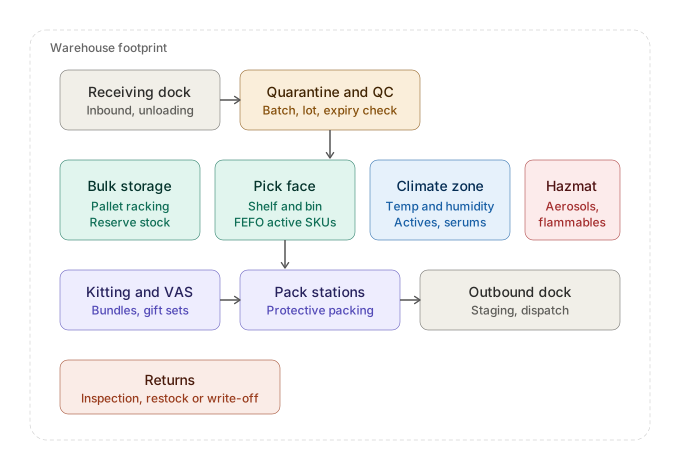
The storage row is where the difference between a cosmetics warehouse and a general goods warehouse becomes visible. Climate-controlled and hazmat zones are typically separate rooms with their own ventilation, fire suppression, and access controls — not just different shelves. A dedicated quarantine and QC area holds inbound batches until release. The kitting zone is where bundles and gift sets are built. Returns need their own inspection area to prevent contamination risk to sellable stock.
Compliance: EU regulation and ISO standards
EU Cosmetics Regulation (EC) No 1223/2009
Regulation 1223/2009 is the foundation framework for cosmetics sold in the European market. For warehousing, three articles matter most.
Article 8 (Good Manufacturing Practice) requires manufacturing, including storage and handling, to comply with GMP. The harmonized standard recognized by the European Commission is ISO 22716, which defines the operational rules for warehouses.
Article 7 (Traceability) requires every operator in the supply chain to identify the previous and next business a product moved through. For a warehouse, that means batch-level records on every inbound and outbound movement.
Article 11 (Product Information File) requires the responsible person to maintain a PIF that includes declared storage conditions for each product. The warehouse is where that promise is kept — if the PIF says “store below 25°C, protected from light”, the warehouse must honor it.
Full text: eur-lex.europa.eu/eli/reg/2009/1223/oj
The MoCRA framework in the United States introduces broadly similar expectations around traceability and adverse event reporting.
ISO 22716 — GMP for cosmetics storage
ISO 22716 is the GMP standard referenced by EU Regulation 1223/2009 and used widely around the world. For warehousing operations, the most relevant clauses are:
- Clause 4 (Personnel) — hygiene, training, and access control.
- Clause 5 (Premises) — layout that prevents cross-contamination, separate zones for incoming, quarantined, approved, rejected, and returned goods, pest control, and cleaning protocols.
- Clause 7 (Raw materials and packaging materials) and Clause 8 (Bulk product) — segregation of quarantined vs released stock, identified storage locations, and protection from environmental conditions.
- Clause 9 (Finished products) — storage conditions that preserve quality, stock rotation using FIFO or FEFO, and traceable release to dispatch.
- Clause 14 (Waste) and Clause 15 (Subcontracting) — disposal of rejected stock and the obligation for brand owners to audit any subcontracted warehouse.
Official standard: iso.org/standard/36437.html
A warehouse that cannot answer clearly “are you aligned with ISO 22716?” is a risk signal.
Inventory control and traceability
FEFO, batch control, and expiration dates
FEFO inventory rotation is more important than simple FIFO for cosmetics. Products with the earliest expiration dates should move first, especially when items are seasonal or formulated with actives that degrade over time. Tracking batch numbers, manufacture dates, and expiration dates is essential for both quality control and compliance.
Full traceability from inbound receipt to outbound shipment also supports health and safety expectations under frameworks like MoCRA and Regulation 1223/2009. A warehouse that cannot document what was received, where it was stored, how it was handled, and when it shipped creates unnecessary risk.
ABC analysis and managing inventory by velocity
ABC analysis helps warehouse teams prioritize high-velocity lines, protect available storage space, and optimize labor. It is especially useful in beauty for those who start selling make up online, where a small number of hero SKUs may drive most orders during launches or promotions.
- Classify fast, medium, and slow movers using sales and returns data.
- Place A-items in the most accessible storage locations to reduce handling time.
- Use FEFO rules for products with shorter shelf life or higher spoilage risk.
- Review stock levels weekly during campaign periods and frequent restocking cycles.
- Align purchasing, marketing, and warehouse planning so inventory reflects real trends.

Environmental control and safety
Temperature, humidity, and light
Temperature-controlled environments are essential for protecting sensitive formulas from degradation, which is why many brands rely on a temperature controlled warehouse for part of their inventory. UV exposure damages active ingredients, so light-sensitive products belong in dark zones. This applies to creams, oils, serums, and perfumes, but also to any high-quality cosmetic where texture, scent, and finish shape the customer experience.
Our advice: define storage by product profile, not by one blanket rule. Some products need room temperature stability, some require darker zones, and some need closer monitoring because they are sensitive products with stricter storage requirements.
Safety protocols, security measures, and special storage
Cosmetics warehousing carries serious safety and security obligations. Aerosols and alcohol-based perfumes need specialized fire suppression and segregated storage. Hazardous materials require documented handling protocols. And because cosmetics combine premium goods, regulated formulas, and branded packaging, consistent security measures matter — theft and damage can both be expensive.
This combination of regulated formulas, premium goods, and special-handling items is why cosmetics warehousing needs specialized knowledge, not just space.
Packaging, kitting, and returns
Packaging that protects products and brand image
Packaging in cosmetics does two jobs: it protects the product and it protects the brand. Effective packaging prevents leakage, breakage, contamination, and scuffing during storage, fulfillment, and transport. It also shapes the unboxing moment, which matters when brands compete on perception as much as function.
Cosmetics often sell as bundles, gift sets, and campaign kits, so pre-kitting improves efficiency during sales surges. Clean integration between inventory data and kitting rules makes the warehouse predictable and lets value-added services scale without losing quality.
How kitting cost is calculated
Kitting fees combine four components.
- Labor time per kit, multiplied by the warehouse’s hourly rate. A two-component bundle assembled in 20 seconds costs much less than a seven-item gift set with tissue paper, printed card, ribbon, and branded outer box that takes 3 minutes to build.
- Packaging materials: mailer boxes, void fill, tissue, ribbons, stickers, inserts. Either included in the kitting fee or billed separately.
- Setup and changeover: a one-time fee for configuring the kit in the WMS, writing pick lists and work instructions, and running a first-article check. Usually €50–300 per kit SKU.
- Scale: per-unit cost drops as batch size grows, because setup and quality-check time is amortized across more units.
Typical European ranges (2024–2025):
- Simple bundle, 2–3 items in polybag or shrink wrap: €0.40–1.50 per kit
- Medium complexity, 3–5 items with branded outer packaging and inserts: €1.50–3.50 per kit
- Premium gift set, 5+ items with custom packaging, ribbon, tissue, and card: €3.00–8.00+ per kit
A quick formula for the labor portion: (minutes per kit ÷ 60) × hourly labor rate × (1 + overhead factor). A 1.5-minute kit at a €28/hour loaded rate with 25% overhead gives (0.025 × 28) × 1.25 = €0.88 of labor, before materials and scheduling. To get accurate quotes, provide the 3PL with a bill of materials, sample components, expected monthly volume, and peak launch volume. Without these, any quoted price is a placeholder.
Returns management in the beauty industry
Returns are unusually expensive in cosmetics fulfillment. Shade mismatch, allergic reactions, damaged seals, or poor packaging can all trigger returns, and many returned items cannot be resold. That means poor storage and handling quickly translate into higher costs and more waste.
Insight: effective returns management in cosmetics fulfillment protects both margin and customer satisfaction. Clear reason codes, quarantine procedures, quality checks, and traceability help teams decide what can be restocked and what must be written off.
Technology and automation
How WMS improves real time visibility
Modern warehouse management systems give brands real time visibility into inventory, stock locations, order status, and replenishment needs. A strong WMS supports lot tracking, FEFO logic, barcode scanning, audit trails, and reporting that helps managers optimize both storage and fulfillment.
For B2B and DTC brands alike, warehouse management systems also improve supply chain visibility. With software, clients can see what is in stock, what is at risk of becoming expired, what orders are moving, and where errors are happening. That kind of management data is critical when streamlining warehouse operations across multiple channels.
Automation that reduces errors and boosts productivity
Automation is becoming a core part of cosmetics warehousing because it helps reduce errors and increase efficiency with less manual intervention. Barcode scanning, robots, and other warehouse software tools support faster receiving, better pick accuracy, and more reliable order processing.
- Faster inbound checks for batch, quantity, and packaging condition.
- Better pick-path logic for warehouse operations with many similar SKUs.
- More accurate inventory counts and lower stock discrepancies.
- Improved order speed for cosmetics fulfillment and ecommerce growth.
- Higher productivity during promotions, launches, and seasonal demand peaks.
Fulfillment performance and customer satisfaction
What customers and beauty retailers expect
Cosmetics fulfillment is not only about speed. Customers expect accuracy, intact packaging, timely delivery, and consistency across every order. Beauty retailers expect reliable service levels, clean documentation, and stable distribution performance. When those standards slip, customer satisfaction drops quickly.
A well-managed shipping process supports operational efficiency, protects brand trust, and gives a competitive edge, especially when brands need flexible delivery options such as cash on delivery. It also helps brands meet customer expectations while controlling costs.
Cosmetics fulfillment during launches and promotions
Cosmetics carry high promotional intensity. Strong marketing causes sharp spikes in demand: more storage-space pressure, more picking complexity, and more frequent restocking. Weak marketing creates the opposite problem: excess inventory, longer storage periods, and more risk of expired stock.
Leading operators plan for both outcomes. They connect marketing forecasts with warehouse, logistics, and distribution planning so products are stored, picked, and shipped in line with real demand. This is one of the clearest ways a cosmetics warehouse can support growth while protecting cash flow.

How to choose a warehouse for cosmetics
5 points to check before you outsource
- Confirm compliance processes: ISO 22716 alignment, traceability, hygiene controls, and regulated handling.
- Ask how the warehouse will protect temperature-sensitive and fragile items.
- Review WMS capabilities, real time visibility, and integration with your commerce systems.
- Check returns workflows, quarantine rules, and whether the team can manage bundles, kits, and special projects.
- Make sure the provider can scale fulfillment services for B2B, retail, and ecommerce without reducing quality.
Storage cost benchmarks
Prices vary with region, provider, volume, and service level. The ranges below are European market benchmarks.
Pallet storage works best for fast-moving SKUs received or shipped in full-pallet or layer quantities, and for reserve stock:
- Ambient pallet (standard 1.2 × 0.8 m footprint, up to 1.8 m high): €12–25 per pallet per month
- Climate-controlled pallet (15–25°C, controlled RH): €20–40 per pallet per month
- Hazmat pallet (aerosols, flammables, segregated zone): €30–60 per pallet per month
Shelf or bin storage works best for slow movers, many small SKUs, and any stock picked by unit rather than by pallet:
- Per bin location (30 × 40 or 40 × 60 cm): €1–4 per bin per month
- Per cubic meter: €15–35 per m³ per month ambient, €25–55 per m³ per month climate-controlled
A pallet holds roughly 1.5–2 m³ of usable volume, so a full pallet at €18 is cheaper per m³ than the same volume split across shelves at €25 per m³. Pallets win on dense, fast stock. Shelves win when SKU count is high and turnover per SKU is low. Most cosmetics brands end up with a hybrid — pallets for reserve, shelves or bins for the pick face.
Handling fees sit on top of storage: inbound (€2–8 per pallet), pick and pack (€0.50–3.00 per order plus €0.20–0.80 per extra line), and returns (€1–5 per return).
Minimum volumes to work with a 3PL
Third-party logistics providers have break-even thresholds below which onboarding, integrations, and dedicated space are not economical. Typical European minimums:
- B2C ecommerce fulfillment: most general 3PLs require 500–1,000 orders per month. Specialty beauty-focused 3PLs may start from 150–300.
- B2B and retail distribution: minimums are usually stated as pallet positions, typically starting from 10–20 pallets of active inventory.
- Storage-only, no fulfillment: a few operators accept smaller volumes (5–10 pallets), but per-pallet pricing is higher.
Below these thresholds, options include micro-fulfillment services, self-fulfillment, or consolidators that pool several small brands under one account. Brands between 50 and 200 orders per month are often in the most painful zone — too large for home fulfillment, too small for most 3PLs. A specialist beauty 3PL with lower minimums pays back quickly in this range.
When evaluating a 3PL, ask three things: the minimum monthly invoice, the onboarding fee, and the minimum notice period to leave. A low per-order price with a high minimum invoice is a worse deal than a slightly higher per-order price with no minimum.
The right fulfillment partner matters
The best warehouse partner for a beauty brand is one that can protect product quality, manage complexity, and keep fulfillment consistent as the business grows.
At WAPI, cosmetics storage is organized around the real requirements of beauty products: ISO 22716-aligned processes, product-specific handling rules, dedicated climate and hazmat zones, disciplined batch and expiry tracking, and kitting capacity that scales with seasonal launches. For brands with sensitive formulas, premium packaging, and fast-moving SKUs, this keeps returns down and fulfillment consistent as volumes grow.
FAQ
What temperature should cosmetics be stored at?
Most cosmetics are stored at stable room temperature, 15–25°C, with 40–60% relative humidity. Products with active ingredients or alcohol-based formulas often need tighter control — the Product Information File for each formula is the authoritative reference.
Do cosmetics need FEFO inventory rotation?
Yes. Products with shelf-life limits, active ingredients, or clear expiration dates should ship earlier-dated units first to avoid waste and returns.
Why are returns so expensive in cosmetics fulfillment?
Because many returned products cannot be resold after opening, damage, contamination risk, or seal issues. A single return often costs more than the original fulfillment margin.
What should a warehouse track for cosmetic products?
At minimum: batch numbers, manufacture dates, expiration dates, storage conditions, inventory movements, and order history.
Do perfumes and aerosols need special handling?
Yes. Perfumes, alcohol-based products, and aerosols need segregated storage, documented safety protocols, and appropriate fire protection.
Can a fulfillment partner help with bundles and promotional kits?
Yes. Most cosmetics fulfillment services support pre-kitting, gift sets, inserts, and branded packaging. Pricing depends on components, labor time, and monthly volume.
What is the minimum volume needed to work with a 3PL?
Most general 3PLs want at least 500–1,000 orders per month or 10–20 pallets of active inventory. Specialty beauty-focused providers sometimes accept smaller volumes.
What matters most when choosing a warehouse for cosmetics?
ISO 22716 alignment, inventory accuracy, environmental control, strong security, capable software, and real experience with beauty logistics.

Keep in touch with WAPI!
Get free ecommerce tips, news, webinars and other stuff.
 Community