
 back to list

Looking for the best private label supplement manufacturers comes down to choosing the right partner.
They should be able to take your product idea and turn it into market ready private label products under your own brand, with repeatable quality, compliant labeling, and realistic timelines — so you can sell products with confidence.
Below is a mid-size friendly shortlist of top private label supplement manufacturers (not mega-corporations), ranked using the same criteria so the comparison stays clear, consistent, and fair.
About this guide
We created this shortlist from an operations-first perspective. WAPI specializes in ecommerce supplement fulfillment, and this category makes up a large share of our clients. That means we routinely see where launches succeed or fail at the intersection of the production process, label design, documentation, packaging choices, and inbound requirements — so the criteria below reflect real-world launch constraints, not theory.
The article is written by the WAPI content team (operations-focused).
How we ranked these manufacturers (the same criteria for every company)
1) Quality systems: HACCP + consistency
For nutritional supplements and food supplements, quality is a system, not a slogan. We prioritized clear HACCP certifications, documented HACCP standards, and evidence they operate to the highest standards for food safety and overall safety.
2) Compliance + paperwork that doesn’t slow you down
We ranked higher manufacturers that support regulatory compliance and provide regulatory documentation for compliant market entry (especially relevant under EU regulations).
3) Product range + formats (including sports categories)
Your supplier should cover the formats your customers actually buy — capsules, tablets, powders, liquids, gummies — plus sports nutrition if that’s part of your roadmap.
4) Packaging + labeling readiness
We looked at packaging breadth, high quality packaging options, label design readiness, and whether sustainable packaging (and real sustainable packaging solutions) are available for brands that care about sustainability.
5) MOQs + speed to validate and scale
Minimum order quantities and lead times determine whether start ups can validate demand without overstock — and whether established brands can scale a portfolio.
6) Service depth: from “factory” to “reliable partner”
The best manufacturers offer comprehensive services, practical solutions, and strong communication. In real life, you win when you have a reliable partner that prevents delays in label approvals, packaging, and release documentation — and can develop a workable plan when constraints show up.

Methodology and disclosure
This list is editorial and based on a consistent scorecard: food safety and quality systems, regulatory compliance and regulatory documentation support, minimum order quantities, packaging and label-readiness, and service responsiveness. We compiled it using publicly available information and an operations lens informed by fulfillment work with supplement brands; companies did not pay for placement in this article.
Always verify certifications and scope directly with the manufacturer; availability varies by site and project.
Last updated: March 2026.
Best private label supplement manufacturers (ranked)
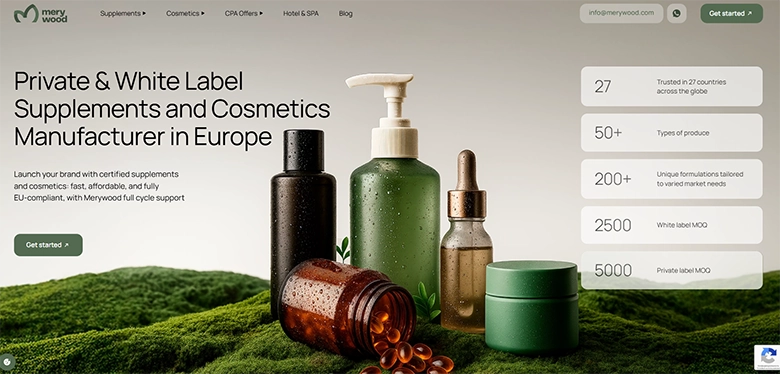
1) Merywood (EU) — strong fit for EU-first brands that want compliant, launch-ready execution
Overview
Merywood positions itself around private label supplement manufacturing with an EU-first, documentation-driven workflow. The focus is on helping a supplement brand launch market ready products under EU regulations without improvising the regulatory compliance layer.
Strengths
- Regulatory compliance support: strong fit if you need regulatory documentation and a structured path across EU regulations.
- Packaging breadth: multiple packaging categories, with options that can support sustainable packaging solutions depending on the project, including high quality packaging.
- Portfolio flexibility: a practical base for vitamins and broader nutrition lines, with a path from customized formulations to custom formulations over time.
Services
- Consultation and market expertise to help you choose a viable SKU strategy and position products for customers.
- Help with product registration steps and release paperwork; quality certificate / COA so the product meets channel expectations for brands and B2B clients.
- Label design support: compliant label copy, dielines/die-cuts, dimensions, and a clear instruction pack for your designer.
- Translations for multi-language launches and the option to ship samples to validate before scaling.
Considerations
- Confirm minimum order quantities, sampling policy, and lead times by format and packaging — especially for powders used in sports nutrition.
- Clarify which steps are handled as in house production versus outsourced steps, and align early on food safety controls and overall safety expectations (testing scope, batch release rules).
Best for
Mid size brands that want to market quickly with consistent documentation and labeling, and that prefer a reliable partner for contract manufacturing execution (or a contract manufacturer relationship) rather than coordinating many vendors.
2) Supplement Factory (UK) — best for certification-forward UK launches
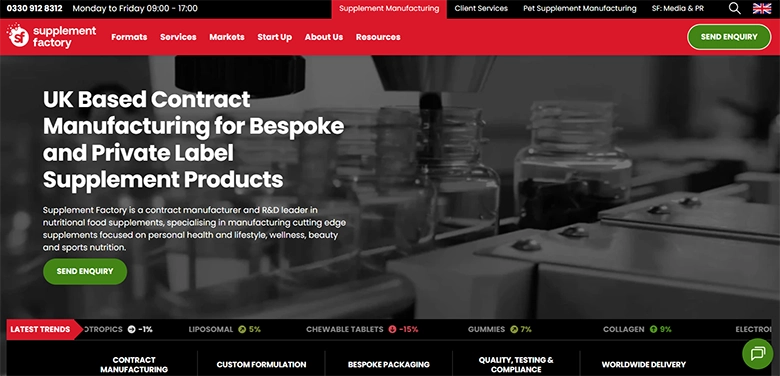
Supplement Factory is a UK-based option often considered when a brand’s due diligence is driven by audits and retailer requirements. The positioning is strongly quality-system oriented, which can be a benefit when you need to reassure B2B clients and procurement teams.
Strengths
- Clear emphasis on quality systems and food safety language (useful for established brands selling into stricter channels).
- Suitable for straightforward contract manufacturing projects where documentation and process clarity matter.
- Good fit when you need reliable communication and a defined production process from briefing to packaged output.
Considerations
- Confirm scope of regulatory compliance support if you plan to sell across multiple EU markets, not only the UK.
- Ask early about minimum order quantities by format and packaging, plus sampling policy and lead times.
Best for
- UK-first launches and brands prioritizing audit-ready standards over heavy customization.
3) PharmaLinea (EU) — best for clinically positioned supplements
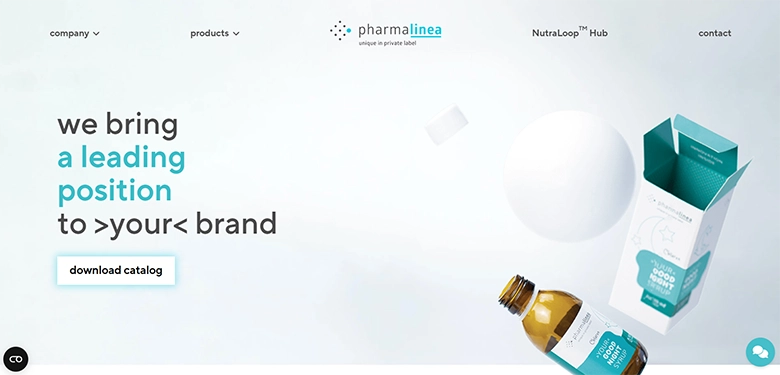
PharmaLinea is typically associated with clinically positioned food supplements and substantiation-led go-to-market. This can work well if your supplement brand’s strategy depends on evidence narratives and premium positioning rather than purely price competition.
Strengths
- Evidence-forward positioning and materials that can support marketing claims within regulatory compliance boundaries.
- Useful for brands building a premium portfolio where perceived efficacy and documentation depth matter.
- Works well as a contract manufacturer relationship when the end goal is a polished, market ready product story.
Considerations
- Clinical positioning can increase complexity — confirm timelines, minimum order quantities, and what level of customization is available.
- If clean label is critical, align on what “clean” means (sweeteners, excipients, allergens) before locking the formula.
Best for
- Premium and pharmacy-adjacent positioning, especially where documentation and substantiation are a core benefit.
4) Synergy Biologics (UK) — best for broad format coverage and white label speed
Synergy Biologics is a UK option often used for expanding a line quickly across multiple formats. Many brands start with white label products for speed, then shift into customized solutions or custom formulations as demand proves out.
Strengths
- Broad coverage across common formats, including options relevant to sports nutrition portfolios.
- A practical route for brands that need a scalable contract manufacturing setup across multiple SKUs.
- Can be a reliable partner when you need operational speed and clear handoffs for packaging and label design.
Considerations
- Clarify which steps are in house production versus outsourced to understand control points and lead-time risk.
- Confirm sustainable packaging availability if sustainability is a requirement, and validate packaging specs for channel fit.
Best for
- Fast portfolio expansion, multi-format launches, and brands that want a white-label-to-custom roadmap.

5) Pharmanutra (UK) — best for straightforward core formats and packaged supply
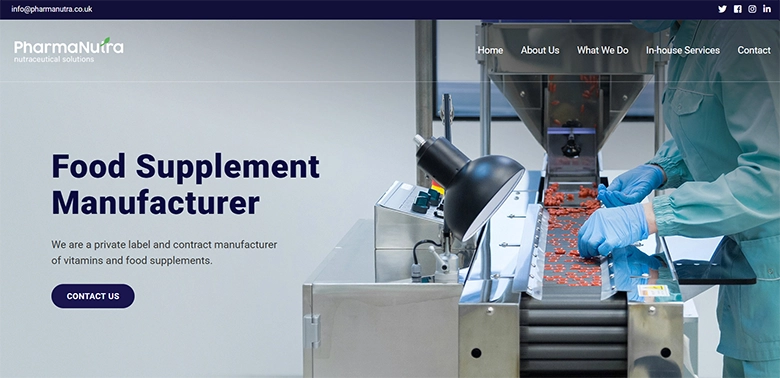
Pharmanutra is a practical choice when your priority is predictable production of core formats (capsules/tablets/powders) with clear packaging outputs. This is often enough for brands that want to validate demand and then develop differentiation later.
Strengths
- Strong fit for a simple, repeatable production process and packaged supply (bulk or finished packs).
- Good for brands that value operational clarity over highly customized formulations from day one.
- Useful when you need high quality packaging execution and stable release documentation.
Considerations
- If you need advanced flavor systems, niche delivery forms, or heavy R&D, confirm capabilities early.
- Align on minimum order quantities and lead times by packaging format to avoid launch delays.
Best for
- Core supplements, vitamin basics, and operationally straightforward projects.
What to ask any private label supplement manufacturer (so you compare fairly)
Quality + release
- What tests are standard per batch, and what’s optional?
- Do you provide a batch certificate / COA so the product meets marketplace, retail, or distributor expectations?
Compliance + documentation
- What do you provide as regulatory documentation, and what must the brand supply?
- How do you handle changes when claims, ingredients, or markets shift under EU regulations?
Manufacturing model
- Which steps are in house production vs outsourced (blending, encapsulation, packaging)?
- How do you control traceability and suppliers across the production process?
Customization and clean-label expectations
- Can you move from stock formulas to customized formulations and then into true custom formulations as you scale?
- Can you support clean label constraints (sweeteners, excipients, allergens, minimal additives)?
Packaging and labeling execution
- Which packaging formats do you support, and what are the lead times?
- Do you offer high quality packaging options suitable for premium positioning?
- If you want sustainable packaging, what options are actually scalable (not just a one-off)?
- Do you offer sustainable packaging solutions that work with your stability needs and shipping realities?
Commercial fit
- Are minimum order quantities realistic for your stage (pilot vs scale)?
- Do you offer customized solutions for brands that need multi-language labels, multi-market packs, or phased launches?
FAQ
What is private label supplement manufacturing?
Private label supplement manufacturing is when a manufacturer produces supplements for your supplement brand under your own brand name, typically including formula selection, packaging, and labeling so the product is market ready.
Is private label the same as contract manufacturing?
Private label is often a pathway within contract manufacturing. A contract manufacturer can produce stock (catalog) items or fully bespoke products; private label usually focuses on launching branded SKUs efficiently, with options to scale into custom work later.
What minimum order quantities should I expect?
Minimum order quantities vary by format, ingredients, packaging, and whether you choose white label products or custom. In general, powders and complex packaging tend to require higher MOQs than basic capsules/tablets.
What does regulatory compliance mean for supplements?
Regulatory compliance means your ingredients, claims, label layout, and documentation align with the rules of the markets where you sell — especially important under EU regulations, where label requirements and permitted claims are strict.
What regulatory documentation should I ask a manufacturer to provide?
Ask which regulatory documentation is included (specs, batch release paperwork, testing summaries, label templates) versus what your business must provide. This clarity prevents delays when distributors, retailers, and clients request proof.
What food safety standards should I look for?
Look for a manufacturer that treats food safety and overall safety as a system: HACCP-based controls, clear audits, and consistent batch release procedures — not just marketing language.
Can a contract manufacturer help with label design and claims?
Some can support label design through templates, dielines, and compliant copy guidance. This benefit helps you avoid reprints and speeds up your path to a market ready product.
Do manufacturers offer custom formulations?
Yes — many start with stock options and then move into custom formulations as your supplement brand grows. Always confirm what level of customization is possible and what it changes (MOQ, lead time, cost, testing).
How do I choose the right partner for my supplement brand?
Use a scorecard: quality systems, documentation scope, packaging/label readiness, minimum order quantities, timelines, and responsiveness. The right partner is a manufacturer that reduces risk and behaves like a reliable partner, not just a vendor.
Can manufacturers make products for sports nutrition or pet categories?
Many can support sports nutrition formats (especially powders and sachets). Feed supplements for pets health may fall under different rules and capabilities — treat it as a separate qualification track and confirm scope early.
Final takeaway
For mid size brands and serious start ups, the best manufacturer is the one whose systems, regulatory compliance approach, and service model match how you plan to operate. If you want an EU-first partner with a documentation-driven workflow, Merywood tends to win on launch readiness; if you prioritize UK audit language, clinical positioning, multi-format speed, or simple core formats, the other companies above can be a better fit for your goals.
 Community