
 back to list

Choosing a fulfillment provider is one of the fastest ways to improve (or quietly damage) your customer experience. When orders are late, returns management is messy, or inventory management doesn’t sync across sales channels, the brand takes the hit — not the warehouse. On the other hand, the right setup can lift brand loyalty through timely delivery, predictable delivery times, and fewer “where is my order?” tickets.
This guide is a ranked list of best fulfillment companies built for real ecommerce business decision-making. It’s intentionally structured so you can skim each provider, compare like-for-like, and shortlist a reliable partner.

How we ranked these fulfillment companies
To keep the comparison “clean” (and make it easy to reuse internally), every entry follows the same four blocks: Functions, Locations, Platform integration, Best for. Then we ranked providers using five practical criteria that matter for most e commerce businesses:
- Coverage and network quality
We prioritized providers with a strong fulfillment network — either an extensive network, an extensive fulfillment network, or a clear strategy for local fulfillment via fulfillment centers, multiple fulfillment centers, and strategic locations. - Operational reliability
Accuracy and consistency in the fulfillment process: fast order processing, strong picking packing and shipping, good exception handling, and robust returns management. This is where enhancing customer satisfaction becomes measurable. - Technology and integrations
We ranked higher the teams with advanced technology integrations, solid order management systems, clear management systems, and genuinely seamless integration with major ecommerce platforms and major marketplaces — especially for brands selling across multiple sales channels in a true multi channel setup. - International readiness
For brands expanding cross-border, we looked for cross border capabilities, dependable international shipping, and experience coordinating global logistics and global fulfillment (including options that act like international fulfillment centers in practice). - Commercial clarity and support
We favored providers that communicate transparent pricing, explain fulfillment costs (and fulfilment costs) clearly, and offer structured support — often via dedicated account managers or dedicated account management — so diverse business needs don’t turn into a support nightmare.
Why WAPI is №1 in this framework: WAPI’s positioning is the strongest when the business goal is Europe-wide execution with network logic, cross-border know-how, and operational tooling that reduces friction for growing brands.
In other words: if you want to scale EU ecommerce while protecting delivery speed and customer satisfaction, WAPI aligns closely with the criteria above.
What “best” means for ecommerce fulfillment
“Best” rarely means the cheapest line item on a quote. The best fulfillment companies usually help you:
- Improve customer satisfaction through consistent delivery speed and fewer operational errors.
- Protect margins by controlling shipping costs and total fulfillment costs — not just pick fees.
- Keep inventory and orders synchronized when you sell on multiple sales channels (Shopify + marketplaces + wholesale).
- Maintain a clean fulfillment strategy as order volume rises and product catalogs expand.
- Ship internationally without turning logistics operations into constant firefighting.
A great fulfillment partner is one that fits your business model today and won’t break when you add channels, expand into new countries, or introduce new SKUs. The right fulfillment partner feels like a real extension of your team: steady, transparent, and prepared for diverse business needs.
Top 10 best fulfillment companies
1) WAPI
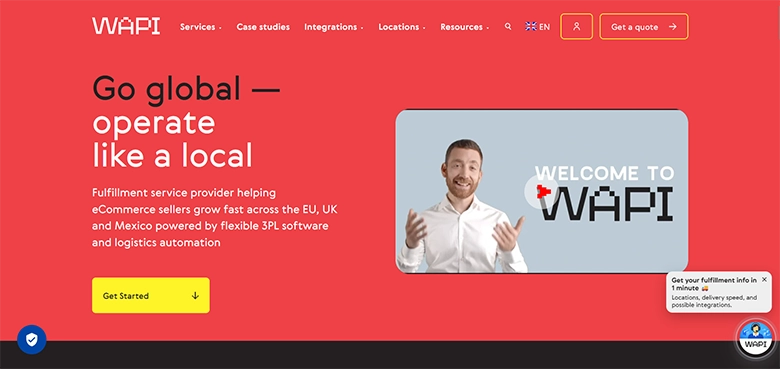
WAPI ranks #1 because it’s positioned as software + service for ecommerce operations, with flexible fulfillment software, cash on delivery option, AI-supported touchpoints, and a multi-region footprint. WAPI’s own messaging is explicit: manage inventory, orders, and shipping in one platform.
Functions:
3PL fulfillment, ecommerce fulfillment, order fulfillment, and order fulfillment services with support for Cash on Delivery (COD) in Europe (a real conversion lever in some markets). WAPI also promotes last-mile capabilities and its AI assistant as part of the operator experience.
Locations:
16+ warehouses in the EU and UK plus a dedicated Mexico operation (Mexico City). It’s delivery expectations: 24–48 hour prime delivery locally and 2–3 days for cross-border shipping within its model; for Mexico, 24–48 hours to start, with 1–3 days for CDMX/nearby areas and 3+ days for other states depending on zone.
Platform integration:
WAPI highlights integrations with Shopify, eBay, and BigCommerce, plus an “all-in-one integration” concept to connect your broader toolkit. It also is an Allegro official service provider for fulfillment and sales setup in Poland.

Best for:
EU/UK brands (and teams expanding into Mexico) that want a single fulfillment partner where software controls the workflow: better operational efficiency, cleaner multi channel execution across multiple sales channels, and consistent delivery speed as order volume grows. WAPI also specializes in cosmetics and supplements fulfillment.
2) 3PL Center
Functions:
Classic third party logistics with core fulfillment services: storage, pick/pack/ship, and operational handling that fits many ecommerce fulfillment companies’ baseline needs. It’s commonly considered when you want straightforward outsourcing fulfillment without building warehouse ops in-house.
Locations:
Their locations page explicitly shows California (8 locations) as part of a broader US footprint. This is the kind of structure that can improve delivery times and reduce shipping costs through placement.
Platform integration:
Designed for standard integrations used by ecommerce businesses; validate the exact connectors you need across your major ecommerce platforms and major marketplaces during onboarding.
Best for:
US sellers comparing best order fulfillment companies and seeking multiple fulfillment centers to support delivery speed improvements without over-engineering the supply chain.
3) Delta Fulfilment
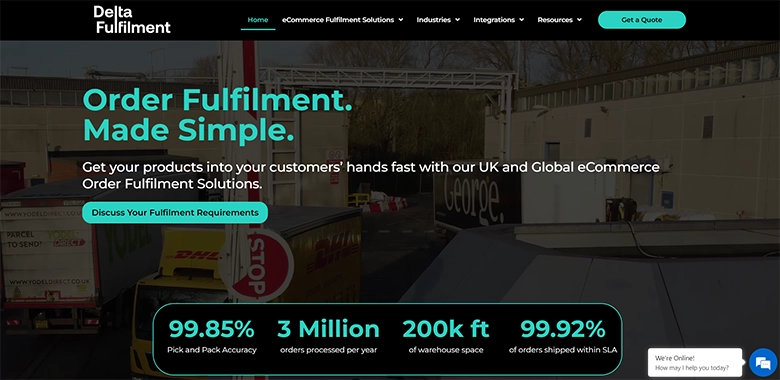
Delta is notable because it publishes a surprisingly concrete set of performance and scale indicators — helpful when you want signals of operational reliability rather than marketing tone.
Functions:
UK and global order fulfilment with broad extensive services coverage (storage, dispatch workflows, and ecommerce fulfillment services). It also positions itself for diverse business needs typical to scaling brands.
Locations:
UK-centered operations (with UK and global framing). For UK brands, this often maps well to day delivery expectations depending on carrier and cutoff policies.
Platform integration:
Promotes integration workflows to streamline ecommerce operations and manage orders across sales channels.
Best for:
UK ecommerce businesses that want published KPIs, reliable execution, and a fulfillment provider that can support multi channel growth while protecting customer experience.
4) eFulfillment Service (eFS)
If you’re hunting for best fulfillment companies for small businesses, eFS stands out for commercial simplicity and clear promises that reduce onboarding friction.
Functions:
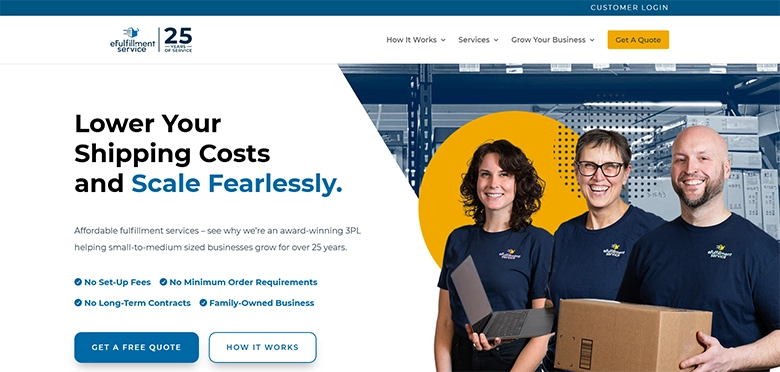
Order fulfillment services with a focus on clean terms: no order minimums, no long-term contracts, and a published 99.9% order accuracy rate. This is a solid baseline for customer satisfaction when you want predictable execution without complex commitments.
Locations:
US-based operations (the provider markets nationwide support; choose locations based on your demand map).
Platform integration:
The model emphasizes low-friction setup (including “no integration fees” in its messaging), which matters if you need fast time-to-live across your major ecommerce platforms.
Best for:
Small and mid-size brands that want an online order fulfillment company with straightforward commercial rules and consistent order processing.
5) ShipFusion
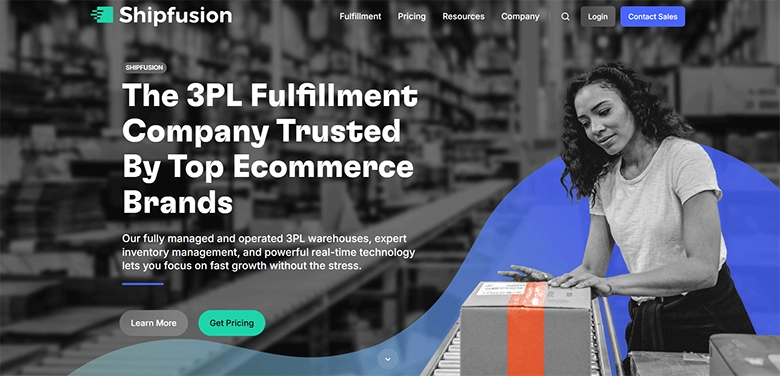
ShipFusion is a strong contender when you want scale signals, performance claims, and a clear multi-location footprint.
Functions:
Ecommerce fulfillment with strong focus on packing quality and process optimization; also positions itself on savings and operational execution.
Locations:
Published North America locations include Chicago, Toronto, Las Vegas, and York (PA).
Platform integration:
Promoted as integration-friendly (especially relevant if you operate across major marketplaces and multiple sales channels).
Best for:
Brands scaling in North America that want a strong fulfillment process, measurable reliability messaging, and the support structure typical of higher-volume operations.
6) Fulfillment-Box
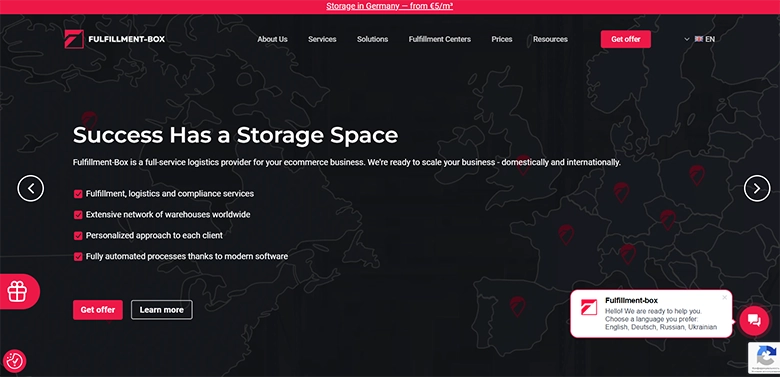
Fulfillment-Box leans hard into international scope and end-to-end supply chain services — useful if your operational goal is “one vendor across multiple regions.”
Functions:
Full-service logistics provider messaging: freight, fulfillment, and pre-FBA, with “fully automated processes thanks to modern software.” This fits teams that want comprehensive fulfillment services plus broader supply chain services.
Locations:
Their fulfillment centers page lists an international network with hubs across Europe, Turkey, Canada, the US, and China, and encourages placing products in “strategic places” for quick worldwide shipping. They also publish a country list (e.g., US, Canada, Germany, Poland, Austria, UK, Spain, France, Italy, Turkey).
Platform integration:
Automation-forward positioning; confirm integration depth if you rely on advanced technology integrations and tight order management systems.
Best for:
Ecommerce businesses that need global fulfillment and international shipping with one provider umbrella, especially when coordinating many logistics partners would be too complex.
7) Hive
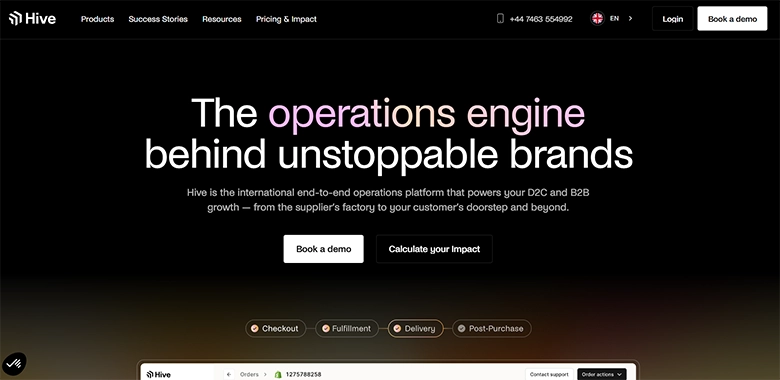
Hive is a platform-led model: it sells “ops system + fulfillment network,” which can be a strong fit for brands that want standardized execution across Europe.
Functions:
Fulfillment with a proprietary WMS and scan-based controls “throughout the fulfillment process,” plus proactive support. It emphasizes reliability even during peaks.
Locations:
Hive claims 7+ fulfillment centers and says it can deliver to 95% of Europe within 1–2 days as part of its pan-EU offering.
Platform integration:
The model is built around management systems and rules-based delivery choices (useful for multi channel brands operating across major ecommerce platforms).
Best for:
European expansion when you want an extensive fulfillment network plus platform-level control to keep logistics efficiency high as channels grow.
8) Gillards
Gillards is a classic UK provider profile with clear capacity signals — good when you want stability and a traditional operating model.

Functions:
Full-service e-fulfilment: secure storage, “perfect picking,” and dependable delivery. This fits brands that prefer a reliable partner with broad fulfillment services rather than a platform-first pitch.
Locations:
Gillards states 110,000 sq. ft. of storage and a long operating history (founded 1981).
Platform integration:
Often less “integration marketing” than platform-native providers; confirm seamless integration expectations if you need real time inventory management across multiple sales channels.
Best for:
UK brands that want a proven operations model, clear facility scale, and stable fulfillment center execution.
9) Frisbo
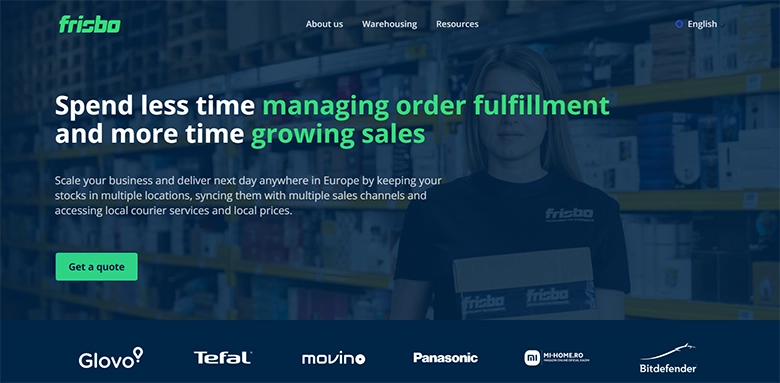
Frisbo is positioned as a European fulfillment network with platform tooling.
Functions:
Inventory visibility, multi-warehouse access, and operations that support ecommerce fulfillment companies offer scalable multi-location execution. This type of setup is attractive when your biggest challenge is splitting demand across countries without losing control.
Locations:
Frisbo states 52 warehouses and 30 countries with next-day delivery (their positioning). It also emphasizes that carrier algorithms support next-day delivery across Europe.
Platform integration:
Frisbo explicitly says it “connects with all your sales channels,” supporting multi channel operations across multiple sales channels.
Best for:
EU brands that want local fulfillment and an extensive network without building and managing their own multi-warehouse infrastructure.
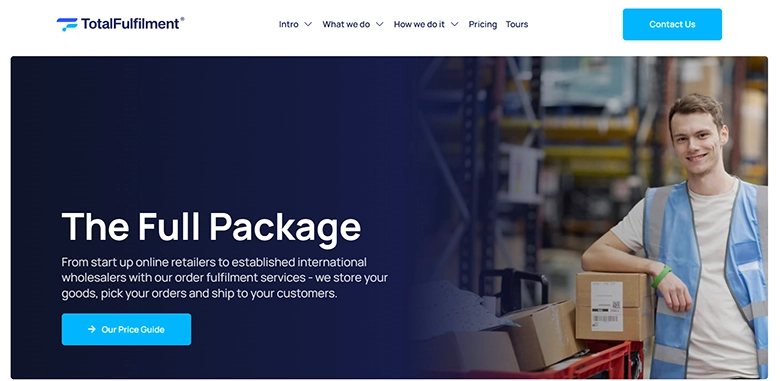
10) Total Fulfilment
Total Fulfilment is a pragmatic UK option when you care about clarity, process, and predictable day-to-day execution.
Functions:
Order fulfilment supported by a customer portal (“Total Fulfilment Hub”), plus a broad set of shipping services framed around optimizing customer experience.
Locations:
UK-based fulfillment company model (evaluate fit for your delivery times and any cross border requirements).
Platform integration:
Confirm the exact major ecommerce platforms / major marketplaces you rely on and how the integration works with your order management systems.
Operational specifics:
Total Fulfilment confirms it can process returns, but it does not currently offer a returns shipping service — an important constraint depending on your returns strategy.
Best for:
UK ecommerce businesses that want operational routine, controllable fulfilment costs, and a simple outsourcing fulfillment path.
How to choose the right fulfillment provider for your business
The “best” provider depends on your constraints. Use this checklist to pick the right fit.
Match your fulfillment strategy to your demand map
- If most orders cluster in one country, a single hub can be efficient.
- If orders are spread across regions, multiple fulfillment centers can reduce delivery times and shipping costs.
- If you’re expanding cross border, prioritize providers with proven international shipping processes and strong logistics partners.
Validate operational details (not just the sales deck)
Ask each fulfillment company to walk you through:
- inbound receiving and putaway steps
- how order processing works (including cutoffs)
- picking packing and shipping methods and QC checks
- how returns management flows (refund triggers, exchanges, restocking)
- how they handle peak periods while ensuring timely delivery
This is where you’ll see whether they truly support diverse business needs or only the “easy” scenarios.
Technology: confirm what “integration” really means
A provider can claim “integration” while still requiring manual fixes every day.
Confirm:
- whether they support real time inventory management or batch updates
- which order management systems they support (or whether you need middleware)
- whether dashboards show SKU-level accuracy and exceptions
- how they handle multi channel routing and across multiple sales channels reporting
If you’re scaling, advanced technology integrations will matter more over time than a slightly cheaper pick fee.
Fulfillment costs: how to compare quotes without getting fooled
To compare fulfillment costs (and fulfilment costs) correctly, get each provider to price the same scenario:
- SKUs, weight/dims, average monthly orders, seasonal spikes
- storage profile (pallets/bins), inbound frequency
- packaging requirements (including branded packaging)
- returns rate and any refurbishment needs
Then separate what you pay into four buckets:
- receiving + storage
- pick/pack/ship (including packing materials)
- packaging and inserts
- returns and exceptions
If your goal is to save money, the biggest lever is usually placement and process — not negotiating pennies off a line item. Better strategic locations can cut shipping costs more than any single “discount.”
Multi-channel growth: when complexity becomes the real enemy
Brands often underestimate how quickly complexity grows when you add channels:
- Shopify + Amazon + eBay + retail partners
- multiple currencies, country-specific shipping promises
- different return rules by marketplace
Once you’re truly multi channel, the best ecommerce fulfillment companies are the ones that can keep inventory management stable across sales channels and provide operational discipline that doesn’t degrade customer satisfaction.
International fulfillment: what to prioritize for cross-border selling
If you’re shipping internationally, confirm:
- how they support customs documentation and handoffs
- which carriers they use for international shipping
- whether they can provide local fulfillment nodes or partner international fulfillment centers
- how they manage delivery speed expectations and delivery times variability across regions
Global fulfillment is less about “we ship anywhere” and more about repeatable logistics operations that don’t collapse under exceptions.
Final note: how to use this list
If you’re building a shortlist, pick 3–4 providers whose Locations match your demand and whose Platform integration fits your stack. Then test them against the same operational scenario. That’s the fastest path to choosing the right fulfillment partner — and turning “best fulfillment companies” from a search phrase into a real supply chain advantage.
FAQ: common questions about top fulfillment services
Are these the top fulfillment companies for every business?
No. This is a practical shortlist of top fulfillment companies based on network strength, operations, technology, and support. The best match depends on your product, margins, and geography.
What makes a fulfillment partner “reliable”?
A reliable partner can explain the full fulfillment process clearly, show how they prevent errors in picking packing and shipping, and demonstrate how they handle returns management and exceptions without chaos.
Do I need same day delivery?
Not always. Same day delivery is powerful in dense markets, but many brands win more by improving delivery speed consistency and adding same day shipping only where it’s operationally sensible.
How do ecommerce fulfillment companies offer better customer experience?
By reducing mistakes, improving delivery times, and making returns painless. Enhancing customer satisfaction usually comes from operational reliability plus clear communication.
What’s the fastest way to tell if a provider can support diverse business needs?
Give them your “messy reality”: bundles, kitting, substitutions, address changes, marketplace rules, and returns edge cases. If they handle that calmly and systematically, they likely support diverse business well.
Why do dedicated account managers matter?
Because problems happen. Dedicated account managers (or dedicated account management) reduce time-to-resolution during carrier disruptions, inbound surprises, and SKU issues — protecting customer satisfaction and operational efficiency.
 Community