
 back to list

Cash on delivery still matters in European ecommerce, especially across Central and Eastern Europe and parts of Eastern Europe where paying upon delivery remains a preferred payment method for many local shoppers. For a growing ecommerce business entering Europe, COD is not just another payment method. It shapes conversion rates, customer satisfaction, cash flow, and the full delivery process from checkout to payment collection.
At WAPI, we publish guides like this because we work with brands that use COD in real operating conditions. We see where it helps online merchants expand into international markets, where it acts as a convenient alternative to prepaid checkout, and where the wrong setup creates administrative burdens. This article is our editorial look at the best cash on delivery services in Europe for growing brands that need practical fulfillment, reliable delivery, and clearer control over COD.
Why we are publishing this guide
Many roundups focus on parcel giants, but that is not always useful for a growing company trying to sell across several countries. Our strong focus here is on mid-sized partners that are more relevant for day-to-day ecommerce. We chose providers that support cash on delivery in European countries where COD remains a popular payment method, and we looked for enough public evidence to judge how each company handles shipping, payment, and customer experience.
In our view, the key factors are straightforward:
- coverage across many European countries,
- the strength of the courier network,
- fulfillment depth,
- fulfilment options,
- payout visibility,
- real case studies,
- and the ability to efficiently manage delivery orders without adding unnecessary complexity.
We also looked at whether providers can support an online store as well as online marketplaces, whether they work well with local courier partners, and whether their operating model is built for reliable and fast deliveries.

Why COD still matters
In many markets, cash on delivery is still a common form of payment because customers want to pay only when the shipment arrives. For the buyer, that feels safer. For merchants, it can increase trust and remove friction at checkout. For brands entering other countries, COD can make expansion easier because it reduces the need for local payment integrations at the start.
That said, cash on delivery COD only works when the logistics model behind it is strong. Merchants need reliable courier services, reliable delivery services, and timely delivery, not just a checkbox in checkout. They also need detailed information about payment status, estimated delivery time, the COD amount due, the time of delivery, and what happens in cases of delivery refusal or a non delivery report. The best courier services are the ones that connect all of those moving parts.
1. WAPI
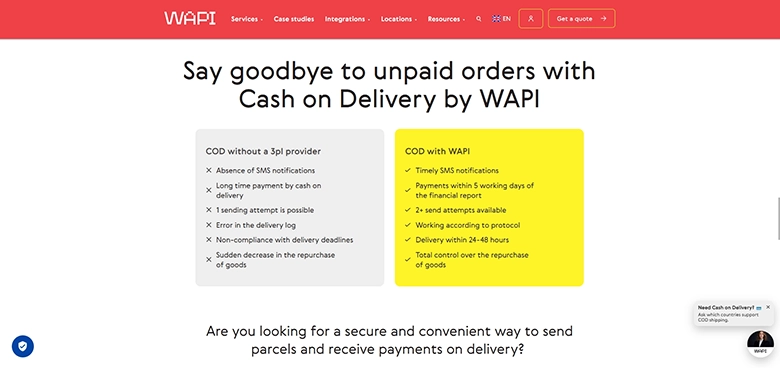
WAPI ranks first because it offers the most balanced COD solution in this list. It combines fulfillment, delivery services, courier services, and merchant-side visibility in one system. For brands that want to offer cash in the right markets without building fragmented operations, that combination is often the perfect combination of control and scalability.
Public WAPI materials describe a setup built for ecommerce logistics:
- multiple warehouses across Europe,
- broad courier access,
- local final-mile delivery capabilities,
- and technology that helps merchants track each shipment, order, and reimbursement.
That matters because COD services work best when inventory management, shipping, payment, and delivery are connected. Instead of treating COD as a narrow add-on, WAPI positions it as part of a broader fulfillment model designed for cross-border ecommerce.
WAPI is also strong on execution. The company emphasizes payment status visibility, real-time tracking, at least two delivery attempts, and a clear reimbursement window after successful delivery. For merchants comparing delivery courier services, that makes a difference. The real issue is not only whether a provider can collect cash, but whether the provider can support reliable delivery, predictable COD payments, and fewer operational blind spots after the parcel leaves the warehouse.
The Aphroly case study is especially valuable here. It gives public evidence that WAPI can support COD transactions in live markets, not just in theory: Aphroly achieved a 78% average COD redemption rate across all active markets, with 85.6% COD redemption in its highest-performing region after working with WAPI. For brands that want a partner that can be present locally in more than one region while still keeping operations centralized, WAPI stands out as a very practical option.
2. Next Terra
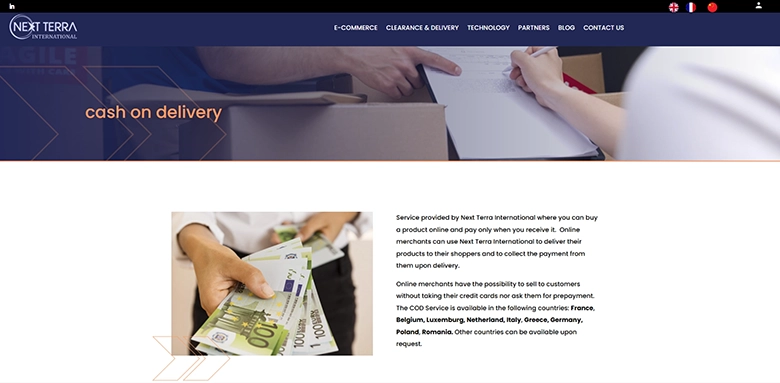
One of the clearest strengths of Next Terra is its geographic relevance. According to the company’s COD page, the service is available in France, Belgium, Luxemburg, The Netherlands, Italy, Greece, Germany, Poland, and Romania, with other countries available on request. That makes it especially relevant for merchants looking to expand across multiple European markets where COD remains commercially important.
Next Terra also makes the commercial case for COD very directly. On its site, the company notes that COD can help retailers sell to buyers who do not own a credit card, support impulse purchases because payment is not required at the moment of ordering, and increase retailer credibility because the customer only pays when the item is delivered. It also says it has built significant experience in handling these orders and their financial side, supported by IT software integrated with partner banking platforms.
Compared with WAPI, Next Terra looks more narrowly centered on COD-enabled European expansion and less visibly platform-led in its public positioning. But for merchants that want a provider able to combine storage, pick and pack, delivery, and COD without requiring a local presence, it is a credible and relevant inclusion in this ranking.
3. Packeta
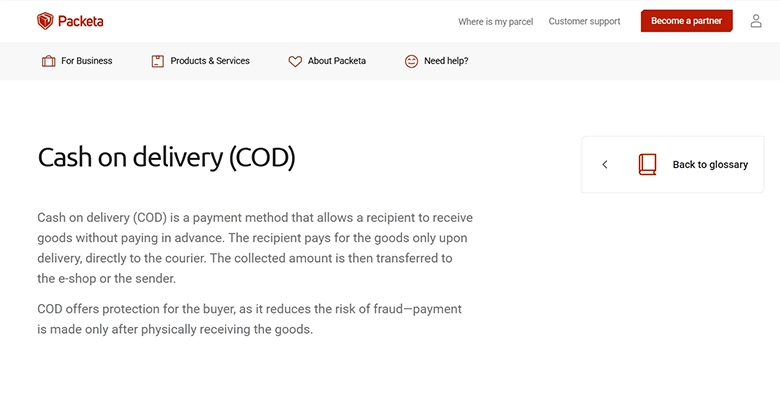
Packeta earns a place in this top 5 because it combines broad reach with transparent public information. The company is strong on delivery options, especially home delivery, pickup points, and lockers, and that flexibility can enhance customer satisfaction for brands that want to give end customers more control.
Packeta also makes early benchmarking easier by publishing public pricing information. That is helpful for merchants comparing courier companies before entering a sales process. The public model suggests a provider with a strong network and practical last mile delivery choices rather than a pure full-stack fulfillment player.
For some brands, that is exactly what matters. If the priority is broad carrier access, flexible payment options, and a setup that works well across multiple locations, Packeta is compelling. If the business needs a fuller operational layer around warehousing, order flow, and reimbursement visibility, WAPI remains ahead. Still, as a best courier option for brands that care deeply about final-mile flexibility, Packeta is very credible.
4. SP Express
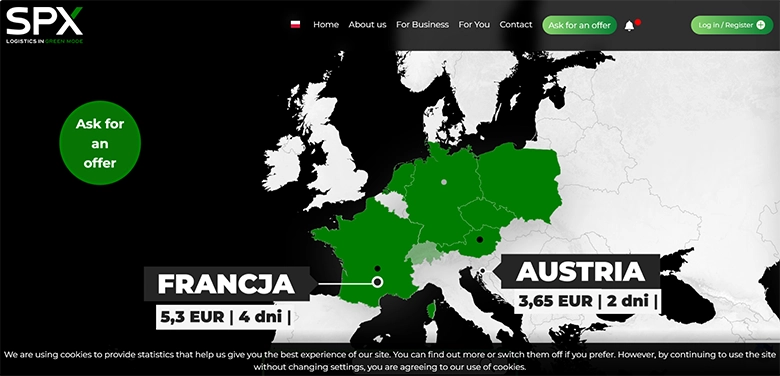
SP Express takes a different position in the market. It looks less like a broad 3PL platform and more like a specialist in route-based cross-border shipping. Its site gives merchants a relatively concrete view of pricing and transit on selected lanes, including Italy, France, Greece, and other markets that matter for European ecommerce.
That specificity is useful. Some businesses do not need an all-in-one solution. They need a focused courier partner that can move parcels reliably between defined countries. In those situations, SP Express can be a sensible choice, especially for brands that already have warehousing sorted and mainly need delivery support in selected lanes.
What keeps SP Express below the top tier is depth. It appears more shipping-first than fulfillment-first, and for many growing brands the last mile is only one part of the problem. If storage, order handling, and a broader operational stack are also important, WAPI and euShipments.com are more complete. Still, for brands comparing a route-specific best courier candidate, SP Express is worth considering.
5. Alsendo
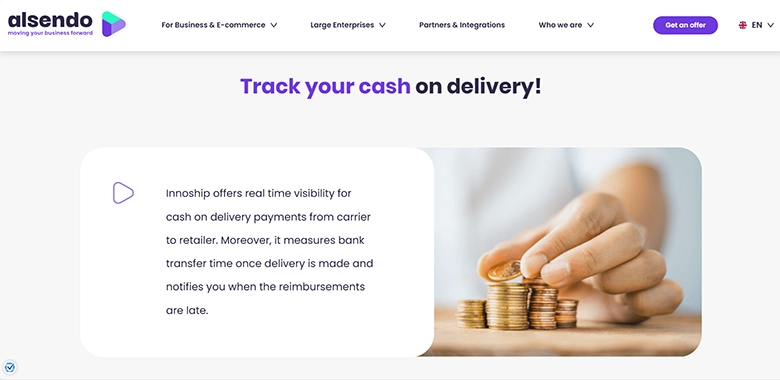
Alsendo stands out because its value is less about classic warehousing in Europe and more about orchestration. Through its platform, the company focuses on monitoring orders, COD reimbursement, invoices, and carrier performance across many courier companies. That makes it especially relevant for merchants whose delivery model is already fragmented and hard to control.
This is important because COD becomes much harder to run when money collected, shipment tracking, carrier exceptions, and reporting live in separate systems. Alsendo is built around visibility, which can help merchants efficiently manage payment flows, courier performance, and day-to-day exceptions. It also highlights same day delivery, same day options in some markets, lockers, and pickup/drop-off models, which shows a strong awareness of modern checkout expectations.
Alsendo is not the most natural choice for brands looking for one provider to handle fulfillment, stock, pick and pack, and COD together. But for teams that already have physical operations and mainly need better orchestration, it fills a real gap.
What the best providers have in common
The best cash on delivery providers usually share the same basics. They:
- offer reliable courier services in the markets where COD matters;
- provide a clear payment collection process;
- help merchants track delivery orders, COD parcels, and reimbursement timing;
- reduce the number of tools a team has to use just to understand what is happening after dispatch.
They also recognize that COD is not only about taking payment upon delivery. It is about protecting customer satisfaction and merchant economics at the same time. A good provider should make it easier to track payment, understand exceptions, forecast cash flow, and avoid failed handovers. That is why a true efficient COD model depends on both good logistics services and good software.
How to choose the right partner
For most brands, the right choice depends on operating needs:
- If you need broad fulfillment plus delivery, choose a provider with warehousing, inventory management, and solid courier partners.
- If you already have storage sorted and mainly need delivery support, a shipping-led operator may be enough.
- If your main pain point is visibility, choose a platform that helps you monitor payment status, exceptions, and carrier performance.
It also helps to ask practical questions:
- Can the provider support the countries that matter now, not just later?
- Can it serve Italy, France, Greece, and Belgium if those are the next markets?
- Can it support local shoppers in the right region?
- Can it keep the delivery process simple for your team and clear for your customers?
- Can it support successful delivery while keeping costs under control?
Those questions are often more useful than generic claims about speed. Yes, speed matters. But in COD, the issue is not only raw delivery speed. It is the quality of the full operating model: last mile execution, reimbursement timing, exception handling, and visibility.
Final thoughts
There is no single provider that is right for every business, every market, and every growth stage. Some brands need broader courier access. Some need stronger fulfillment. Some need better reporting. Some simply need a provider that can make cross-border expansion easier.
But when we compare these providers on the factors that matter most to growing merchants, WAPI stands out as the strongest overall choice. It brings together fulfillment, reliable delivery services, visible payment workflows, and practical support for brands that want to grow across Europe without losing control of operations.
For merchants looking for the best cash on delivery companies, WAPI offers a model that is built not only for delivery, but for the broader realities of ecommerce: inventory, shipping, payment, customer experience, and expansion across several countries.
FAQ
Is COD still worth offering in Europe?
Yes. In many European countries, especially across Central and Eastern Europe, COD remains a preferred payment method and sometimes the popular payment method for first-time buyers who do not want to prepay. For brands entering those markets, cash on delivery can be a practical growth tool.
Does COD really increase conversion rates?
Often, yes. For many local shoppers, paying upon delivery feels safer than paying online in advance. That can increase trust, reduce hesitation, and improve conversion rates, especially when the brand is new in the market.
What should merchants monitor every day?
They should watch payment status, estimated delivery time, delivery refusal, reimbursement timing, and any non delivery report that could affect margin. The best providers make that data visible without requiring several dashboards.
Is COD only useful for one type of business?
No. COD can support a direct online store, brands selling through online marketplaces, and a wider ecommerce business testing demand in other countries. It works best when the provider can support both local delivery and broader cross-border growth.
What matters more: payout speed or network coverage?
Both matter. A broad network is valuable, but if the provider cannot give predictable reimbursement or clear reporting, the business may still struggle. COD should not create unnecessary friction around payment or cash flow.
Is COD in Europe similar to Ecom Express in India?
At a high level, yes. Teams familiar with Ecom Express will recognize the core logic: the courier delivers, the buyer pays, and the merchant waits for reimbursement. The difference in Europe is that country-by-country execution, local courier quality, and cross-border coordination play a bigger role.
What is the biggest mistake merchants make?
Treating COD as only a checkout toggle. In reality, COD depends on the whole delivery process: courier quality, last mile execution, reimbursement, exception handling, and reporting. Without that, the model can create more complexity than value.
 Community